Galaxy S9 and S9+ battery test: The disappointing truth
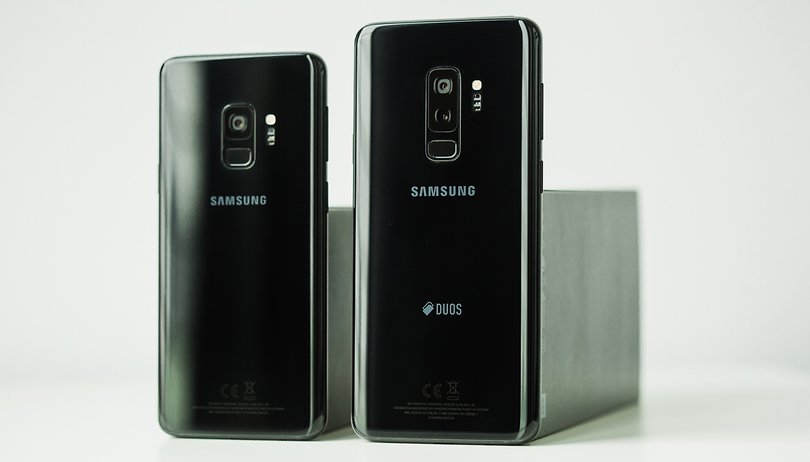

The new Galaxy S9 and S9+ are a reflection of their predecessors, the S8 and S8+. This is true to the extent that their batteries have the same capacity: 3000 mAh for the S9 and 3500 mAh for the plus version. So the question is, how has the battery life responded to the increase in power? We analyzed the S9 and S9+ battery in detail.
The autonomy of Samsung’s new flagships leaves something to be desired
Let’s face it, we expected this. By the time the data on the battery capacities of Samsung’s new flagships was leaked, doubt spread like wildfire. The press and users already know what happens when you put a more powerful processor with the same battery. It’s almost the inverse of what happened from the Huawei P9 to the P10, as the P10 increased its battery life, but decreased its power.
But let’s see how the new hardware has affected the battery life in the newest member of the Galaxy S series.
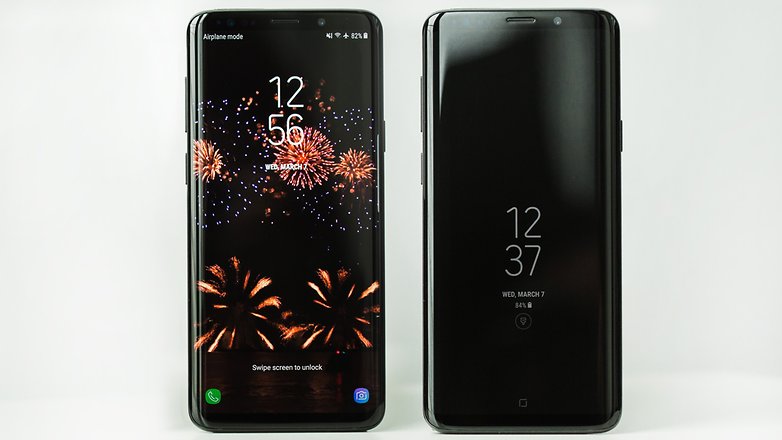
The S9 offers 12 hours of autonomy at half gas without any problems
The S9 features a Snapdragon 845 processor in the U.S. (Exynos 9810 in all other regions) along with 4 GB of RAM and 3000 mAh of battery power. We tested the Exynos processor, which gave the S9 and S9+ the best overall performance we have ever tested. With more power than the Galaxy S8 and the same battery, the S9 is able to stay for 12 to 16 hours with just over 4:00 hours of screen time. These are values for daily use with videos (more than hour), games (more than hour), lots of messages and emails, some geolocation, use of specific apps and plenty of internet browsing.
The optimized mode (recommended by Samsung) with automatic brightness and screen resolution at FHD+ was used to obtain these results. When you play games, the mode changes to optimize the game by increasing the resolution to WQHD+ and the screen brightness by 10%.
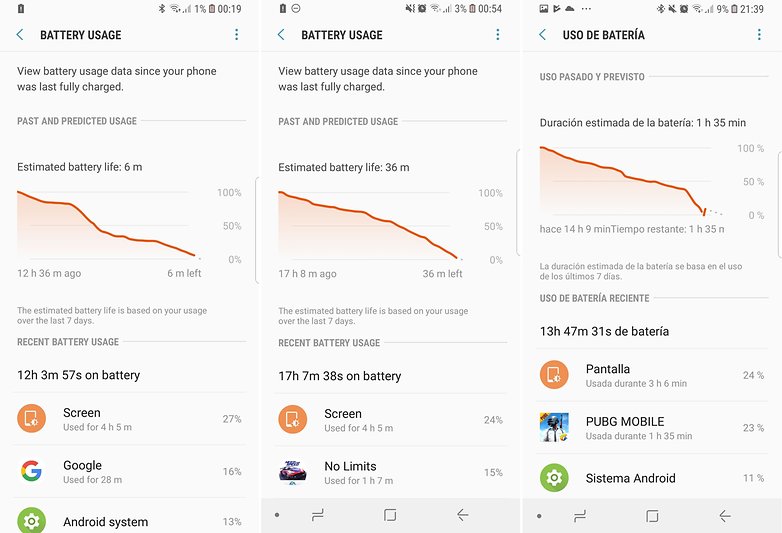
In somewhat unusual scenarios where I haven’t used the smartphone much, the battery life exceeded 18 hours, but with only about 2 and a half hours of screen time. The most I’ve stretched the screen time while watching movies and videos amounted to nearly 6 hours.
The processor may be more efficient than the previous one, but it is also more powerful, and the power consumption has inevitably increased. The reduction in battery life is significant when we see that the S8 could handle 6 hours of screen time in standard use.
S9+ autonomy is more of the same, 3 hours of screen time with maximum resolution
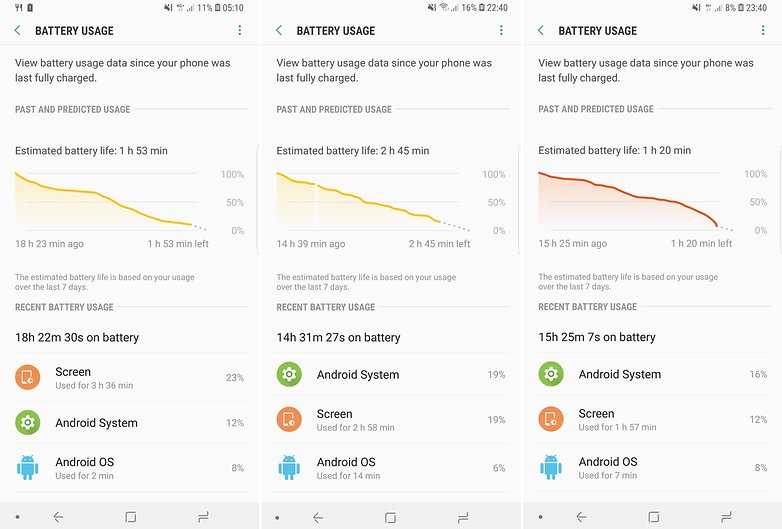
Both the S9 and S9+ have the same processor, but in the plus version it comes with 6 GB of RAM and a 3500 mAh battery. In terms of battery life, there is no difference in hardware or battery capacity. The S8+ battery basically offers autonomy for a 12-16 hour journey, just like the S9. In this case the difference between it and its predecessor is somewhat more pronounced. The S8+ could reach 5-7 hours of screen time with WQHD+ resolution activated.
As you can see in the screenshots from my colleague Luca Zaninello, screen time doesn’t exceed the 4-hour barrier with WQHD+ resolution. When Luca used the Pixel 2 XL in the sam way, he got 7 hours of screen time.
Samsung Galaxy S9 and S9+ PCMark battery life benchmark
| Smartphone | Duration | Capacity (mAh) |
|---|---|---|
| Razer Phone | 10:43 hours | 4,000 |
| Nokia 8 | 9:25 hours | 3,340 |
| Samsung Galaxy S9 | 7:15 hours | 3,000 |
Does it at least recharge quickly?
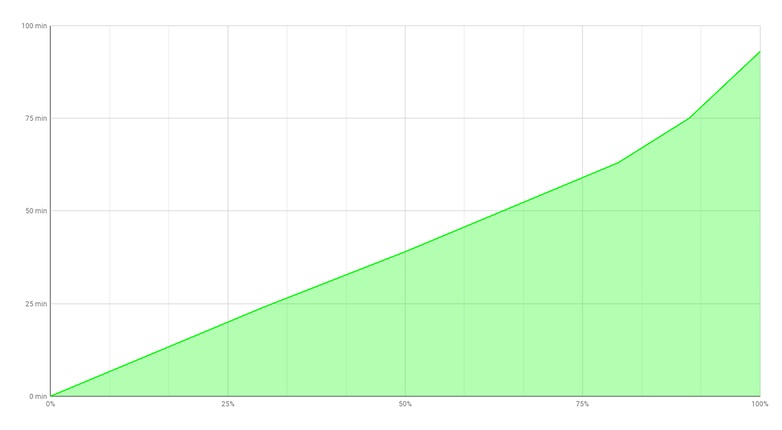
Yeah, yeah. The battery can be charged as fast as it gets drained (note the irony). Seriously, at least the fast charge is still as good as ever. In the first few minutes of charging, the percentage goes up quite quickly, but it takes about an hour and a half to reach 100%. One important point is that the charger is as small as they come and is easy to carry, especially if you compare it to The Dash from OnePlus. The following chart compares the charging time to the charging percentage: the more horizontal the curve, the faster the device loads.
Conclusion: It lasts a day without many luxuries
Samsung’s top-range device can survive a day of use in 2018. But I don’t mean 24 hours, I mean the time from when you wake up until when you go to sleep. And that’s in optimized mode. If you want higher performance or to maximize the screen resolution, the battery life is drastically reduced.
Samsung equips the S9 and S9+ with several energy-saving options that can stretch the stored energy a bit further, but they require sacrificing some premium options like maximum performance or fabulous screen resolution. This is a shame for how much you need to spend on a flagship in 2018.
What do you think of these findings? Would you still be interested in purchasing the Galaxy S9?








Samsung galaxy s9 is by far the best Android phone I've ever had.... second time owning one and can never dissapoint.. great for gaming.... great for videos, quality definitely is worth the extra money....
Blatant lies. My S9 lasts more than 8 hours screen time on, 2 days.
Things could improve with further software balancing. It's not ideal,but Samsung is pretty good about maintenance updates. The s6 line was still receiving updates at nearly 3 years old.
This has not been my experience with my SD845-powered S9+. I do wonder why there is such a huge difference in results. Here's how my first 12 days with the phone have been going:
I consider myself a heavy user. I watch a lot of videos on Netflix and Youtube, I play games, mainly on Emulators and I do go on social media like Facebook quite a bit, as well as the usual everyday texting. I've been getting around 5 to 7 hours of SOT on a normal day where the phone is unplugged at 7am and remains that way until I go to bed, whenever that is, usually with 15-25% of battery left. This is no surprise to me, as the AMOLED 6.2'', WQHD+(2960x1440) display must be quite power consuming, especially in apps with a white background.
No, the real surprise for me is the idle power consumption. I am coming straight from a 2 year old (ish) S7 Edge (Exynos Variant), which was the best performer in battery life from Samsung that year. It has a larger battery (3600mAh) than the S9+, a decently smaller screen (5.5'') with slightly less pixels (2560x1440) and the screen was not as bright. Despite all of this, I was getting around the same SOT, 5-7, with a big difference. I did notice that the battery was draining slower when the screen was on, however the S7E was losing around 1% of battery every 15-20 minutes at idle, with nothing playing on it except the AOD. By comparison, the S9+ is only losing around 1% every 45-50 minutes in the same conditions. Also note that I do have all the same apps installed on my S9+, as they were automatically restored when I powered on my new device.
To me, this is the biggest improvement they've made. It means when I go camping as I usually do, I'll be able to turn on the power savings and count on the fact that the battery won't drain at idle like it used to.
But I'd like to know if anybody else has experienced what this article is mentionning, as there might be an issue with some variants of the S9+, depending on region.
Ditched my S7 after exactly one year. reasons why were: extremely poor battery life, bloatware, the way Samsung made a mess of the settings menu and the constant interference of Samsung want me having an account. Tried Samsung once but will never buy one again. I'm now (again) a very happy Motorola user (Moto Z2 play): excellent battery life (charge it once every 24 hours from around 50% to 90% at medium use), no bloatware, Android as Google designed it with some very usefull features from Motorola.
I don't know what phone you guys are testing....
I've had my S9+ for a week now and I'm getting 6 hours of screen on time every day on high performance mode with auto brightness turned on. This is on wqhd+ with 10% brightness boost. I have the Qualcomm version FWIW.
I'm definitely a heavy user. Lots of videos and gaming. I'm super happy with the battery life I'm getting. Did I just get lucky or something?
They tested the exynos versions. I have the S9+ getting between 4 and 5 hours SoT. Do you charge your phone overnight?
I know right? I mean, I owned an S7 Edge until March 16 when I got the S9+ (Canada, so SD845), and I've been getting about 5-6 hours of screen-on time every day with quite heavy use of badly optimized apps (The F1 app, emulators, the new Firefox Beta). I don't consider charging my phone overnight to be an ''issue'', and honestly, my roommate, who isn't a heavy user like me, also bought one and is charging it only every 2 days. The biggest difference for me between my S7 Edge and my S9+ is the Idle power consumption. My S7E was losing about 1% every 15-20 minutes at idle with the AOD, while my S9+ is losing about 1% every 45-50 minutes if I don't use it, also with the AOD.
I was thinking they might have had a lemon or maybe they put it in High Performance mode at all time for no good reason?
The Zenfone 3 Zoom taught me one thing: battery life isn't the only thing, it is everything. This is the first (smart)phone I've had where I don't need to worry about the battery at all. I've stopped charging it in the car during the commute because I don't need to, the 5k battery lasts through a day of heavy use easy and can make it through a second one under most circumstances.
I would like to buy a nicer phone with a better camera and more ram, but I'm currently unwilling to give up the freedom the 5k battery allows me.
Samsung always struggle with software updates and things running on there phones,you always have to disable loads of functions on Samsung phones to get better batterylife,i always disable the functions i rarely use,like Samsung preinstalled applications like Samsung music plus some of the others.just updated my S8 plus to 8.0 the same as what is on the S9 models,and hope Samsung as damaged the batterylife now
Bring back the removable battery then battery life does not matter because you can always have a spare or 2. Get an external charger 3 batteries never have to worry about battery life again. 1 in the phone, one on standby , and one in the charger. The other plus is your phone works better because you are always doing a reset by removing the battery. Something you can not do with a sealed battery a hard reset does not work the same because it never complete loses power.
Ak!
It's soooo annoying.
Battery life is going to be what separates everyone pretty soon. The new Chinese players are doing fabulous things.
Let's see where this goes....