


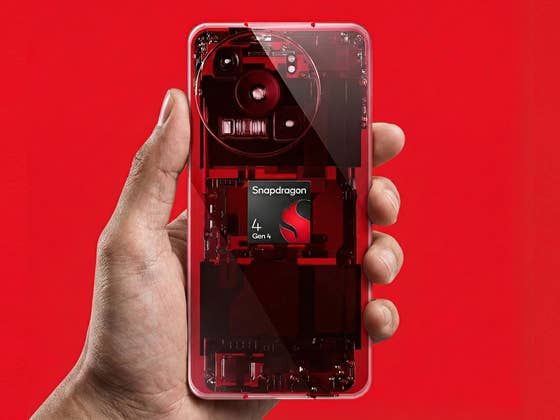
Those who opt for budget or mid‑range smartphones might find their next device noticeably faster. Qualcomm has just unveiled the Snapdragon 4 Gen 4, one of its lower‑end mid‑range mobile chipsets. The new silicon brings sweeping upgrades, especially in processor and memory, which could make affordable phones substantially more powerful.
Flagship Cores Come to Budget Processors
The new chip skips Gen 3, following the Snapdragon 4 Gen 2. That leap appears justified. Built on a 4 nm node, the Snapdragon 4 Gen 4 now uses faster and more efficient Kryo cores. This marks a notable shift from the Cortex cores, with Qualcomm claiming a 15–20% performance boost.
Technically, it’s based on an 8‑core 2+6 configuration, with performance cores clocked up to 2.3 GHz (up from 2.2 GHz) and efficiency cores at 2.0 GHz (up from 1.9 GHz).
More Capable Graphics
On the graphics side, the Snapdragon 4 Gen 4 features a significantly more powerful Adreno GPU, delivering around 20% faster performance than the Adreno 613 in the Snapdragon 4 Gen 2. While benchmarks aren’t yet available, the new GPU should provide more stable frame rates at higher levels. It also supports OpenGL ES 3.2, Vulkan® 1.1, FHD+ resolution, and 120 Hz refresh rates.

Memory sees a major upgrade too, with support for LPDDR5, putting the chip closer to pricier counterparts. Compared to LPDDR4X in the previous generation, this means smoother performance and faster multitasking. However, adoption depends on manufacturers enabling it in their devices.
Camera and Connectivity Stay Familiar
Elsewhere, the chip supports faster UFS 3.1 storage and USB 3.2 Gen 1. The camera capabilities remain largely unchanged, with support for sensors up to 108 MP, though video recording is still capped at 1080p at 60 fps.
Wi‑Fi 5 remains the same, but 5G connectivity supports global multi‑SIM with download speeds up to 2.5 Gbps.
Despite retaining many of the imaging and connectivity features, the Snapdragon 4 Gen 4 is a meaningful upgrade. It should deliver noticeable improvements in raw performance, particularly for demanding tasks like editing and gaming.
No brand has yet confirmed devices with the new Snapdragon 4 series chip. However, based on the adoption of the Snapdragon 4 Gen 2, successors to the Xiaomi Redmi 14C/14R and POCO M7 are likely candidates.
Do you think mid‑range smartphones are already capable enough for decent gaming? What improvements would you like to see in them? We’d love to hear your opinion.
We mark partner links with this symbol. If you click on one of these links or buttons–or make a purchase through them–we may receive a small commission from the retailer. This doesn’t affect the price you pay, but it helps us keep nextpit free for everyone. Thanks for your support!