Sorry, but there's really nothing to see here right now. Our server is in maintenance mode – and our
little bot is trying to sort the error messages with its last bit of energy.
Whether it was a data leak, a power outage in the cluster, or just a grumpy bit – we don't know yet.
But what we do know is:
The data drama escalated into a server meltdown. But don't worry: We're on it.
What now?
Everything is surely running smoothly over at our colleagues from inside
digital – why not stop by!
Or you could pass the time by visiting our social media channels – for example Instagram, YouTube or TikTok. At least there are no
server problems there – promised.
Thanks for your patience. Our bot is already rebooting at full speed. 🔧
NewsTabletMid-range Phones Begin Their On-Device AI Journey
Numerous AI features are available mostly on flagship smartphones, leaving mid-tier handsets out of the equation. This is primarily due to chipsets in this category being incapable of handling resource-intensive processing. That’s beginning to change as chipmakers like Qualcomm are introducing more capable mid-range SoCs, such as the new Snapdragon 7s Gen 3.
Also read: Mid-range mobile processors compared
Announced today, the Snapdragon 7s Gen 3 is poised to be fitted in mid-range and premium Android smartphones. It’s a toned-down version of the Snapdragon 7+ Gen 3 that was launched last year. However, the new silicon is enabling advanced AI experiences on a wider range of devices.
On-device generative AI features in a mid-range Android handset
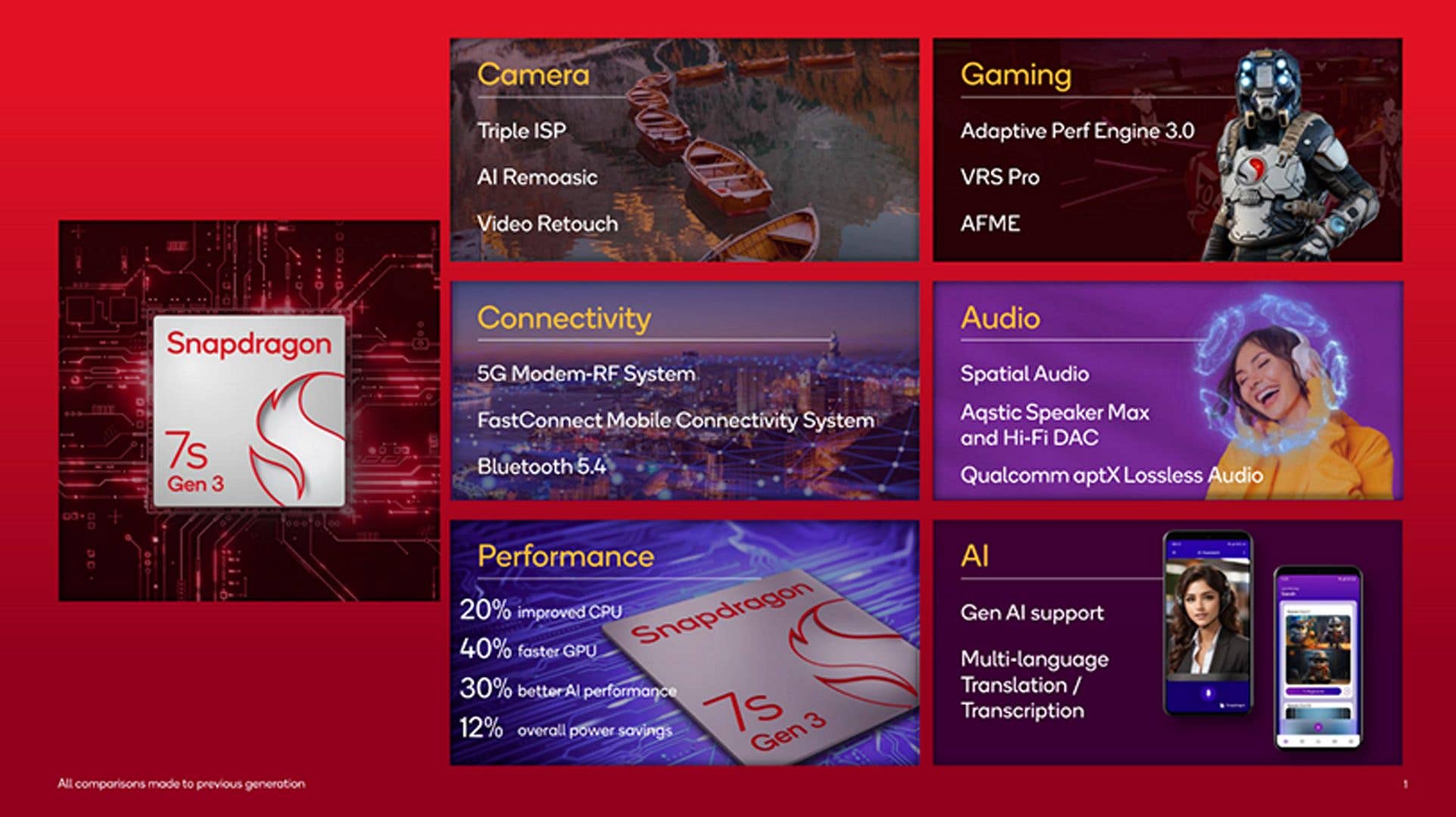
On the neural processing front, the Snapdragon 7s Gen 3 features on-device generative AI capabilities with support for many LLMs (Large Language Models) like Meta’s Llama 2. This should enable functions such as multi-language translation and audio transcription, which are available on both select Samsung Galaxy and Google Pixel smartphones.
Qualcomm also added the chipset is 30 percent faster when processing AI tasks compared to its predecessor from last year. The use of AI extends to the imaging department for better photo quality with AI-powered noise reduction, dual capture, smoother zooming, and 4K HDR video recording.
Regarding the CPU and GPU, Qualcomm stated the Snapdragon 7s Gen 3 should offer 20 percent improved processor performance and about 40 percent better graphics. Even better yet is how Qualcomm touted the mid-range chip is 12 percent more efficient, drawing less power while delivering faster speeds overall.
The CPU has an octa-core configuration headlined by a primary Kryo core clocked up to 2.5 GHz. The rest of the setup includes three performance cores that run up to 2.4 GHz and four efficiency cores at speeds of up to 1.8 GHz clock speed. Manufacturers can also pair it with up to 16 GB of RAM.
The Snapdragon 7s Gen 3 supports displays with up to FHD+ resolution and a 144 Hz refresh rate, alongside an Adaptive Performance Engine 3.0 for enhanced gaming. In addition, the chipset has an array of connectivity options, including Bluetooth 5.4, Wi-Fi 6E, and 5G mmWave.
Xiaomi is set to launch the first smartphone powered by the Snapdragon 7s Gen 3 SoC this September. Meanwhile, more devices with this chip are expected to arrive in the coming months.
Do you intend to get a Snapdragon 7s Gen 3 SoC-powered device? Which AI features do you look forward to in upcoming mid-range smartphones? Share your answers in the comments.
We mark partner links with this symbol. If you click on one of these links or buttons–or make a purchase through them–we may receive a small commission from the retailer. This doesn’t affect the price you pay, but it helps us keep nextpit free for everyone. Thanks for your support!








0 comments