

Headphones with Active Noise Cancelling (ANC) have long been part of everyday office life. They block out conversations, keyboard clatter, or the constant noise of open spaces – handy when the next video conference is taking place next to you. However, this is precisely where the TÜV association sees a risk: using headphones as a permanent solution can undermine health, communication, and even occupational safety.
ANC is not hearing protection
The classification is important: noise-canceling headphones look similar to over-ear earmuffs, but are not personal protective equipment. This may seem obvious at first, but there is an important reason for this distinction.
Inside an office building, the noise level should theoretically fall somewhere between 35 and 40 decibels. This is “quieter than a normal conversation”. The key point: an office should be designed to support concentrated work during normal operations, even without a noise cancellation workaround. If ANC becomes standard equipment in a team, this is often an indication of an acoustic problem rather than a clever productivity culture.
The typical mistake: ANC On – Volume Up
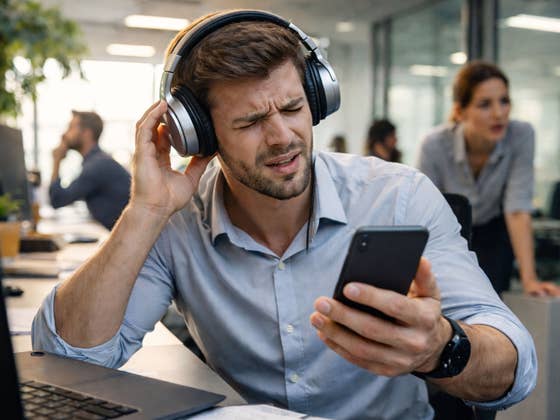
The biggest stumbling block, however, is not the noise canceling itself, but the surrounding environment: many people turn up the volume because the surroundings can be tuned out by ANC. As a result, the actual sound exposure to the ear can quickly become too high – especially with continuous use. Everyone is probably familiar with this mistake.
There are also effects that not everyone experiences to the same extent: some people react to noise suppression with dizziness, a sense of pressure, or mild nausea. According to TÜV expert André Siegl, ANC is not automatically harmful to your health – the decisive factor is how you use it. Functions such as an automatic volume limiter, which many models offer or which you can activate via your smartphone or end device, are useful.
Taking breaks helps more than perfect headphones
If you use ANC at the office, you need rules that don’t just rely on technology. Above all, TÜV recommends taking breaks: leave your headphones off for five to ten minutes every hour. This is banal, but effective, because your ears and head can hear and process “normally” again in between.
Continuous ANC can also be socially upsetting: If you are constantly isolated, you miss out on questions, spontaneous discussions, or even warning signals. Many headphones have a transparency mode that lets ambient noise through at a reduced level. This can be a better solution at the office than “completely sealed off”, especially if you need to remain reachable.
By the way: Siegl recommends instrumental pieces rather than vocals for concentration. Alternatively, you can work with (white or brown) noise – many apps and smartphone functions provide this without much effort.