

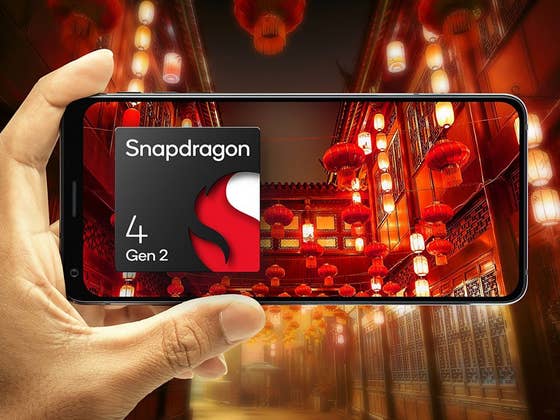
Leaked last week with the Xiaomi Redmi Note 12R last week, the Snapdragon 4 Gen 2 is the first entry-level smartphone processor on a 4nm-class technology—presumed to be Samsung’s 4LPP process node—which should offer better energy efficiency than rivals on Samsung’s 5-nm nodes or even TSMC’s N6, such as the previous generation Snapdragon 4 Gen 1.
| Snapdragon 4 Gen 2 | Snapdragon 4 Gen 1 | Dimensity 7020 | Exynos 1330 | |
|---|---|---|---|---|
| Performance cores | 2x Cortex-A78 @ 2.2 GHz | 2x Cortex-A78 @ 2.0 GHz | 2x Cortex-A78 @ 2.2 GHz | 2x Cortex-A78 @ 2.4 GHz |
| Efficiency cores | 6x Cortex-A55 @ 2.0 GHz | 6x Cortex-A55 @ 1.8 GHz | 6x Cortex-A55 @ 2.0 GHz | 6x Cortex-A55 @ 1.8 GHz |
| Memory | LPDDR5X-6400 2x 16-bit @ 3200 MHz (25.6 GB/s) |
LPDDR4X-4266 2x 16-bit @ 2166 MHz (17.0 GB/s) |
LPDDR5 |
LPDDR5 |
| GPU | Adreno Vulkan 1.1 |
Adreno Vulkan 1.1 |
PowerVR BXM-8-256 Vulkan 1.3 |
2x ARM Mali-G68 Vulkan 1.2 |
| ISP | Up to 108 MP (Spectra) |
Up to 108 MP (Spectra) |
Up to 108 MP (Imagiq) |
Up to 108 MP |
| Cellular modem | 5G (sub-6GHz) (Snapdragon X61) Up to 2500 Mbps |
5G (sub-6GHz) (Snapdragon X51) 2500 Mpbs |
5G (sub-6GHz) Up to 2770 Mpbs |
5G (sub-6GHz) (Exynos) Up to 2500 Mpbs |
| Wireless connectivity | Wi-Fi 5 Bluetooth 5.1 (FastConnect) |
Wi-Fi 5 Bluetooth 5.2 (FastConnect 6200) |
Wi-Fi 5 Bluetooth 5.2 (Filogic) |
Wi-Fi 5 Bluetooth 5.2 |
| Manufacturing process | Samsung (4nm-class) | TSMC N6 (6nm-class) | Samsung (5-nm class) | |
Qualcomm advertises up to a 10% performance increase for the Snapdragon 4 Gen 2 over the 1st generation, which lines perfectly with the clock speed increase, as both generations use the same CPU cores—Cortex-A78 for performance, and A55 for efficiency.
In other performance specs, the new Snapdragon 4 Gen 2 packs an LPDDR5X-6400 memory controller which offers 50% faster bandwidth than the LPDDR4X-4266 controller on the 4 Gen 1 chip. And the storage department got a near 2x performance bump, being compatible with the UFS 3.1 standard, versus UFS 2.2 on the previous generation.
On the all-important camera processing side, the Snapdragon 4 Gen 2 got a curious downgrade compared to its predecessor, with a double Spectra ISP instead of the triple ISP on the 4 Gen 1. In practice, it means that phones with the new phone will be able to process data from only two cameras simultaneously. Qualcomm promises, however, faster auto-focus, and better image stabilization and noise reduction features.
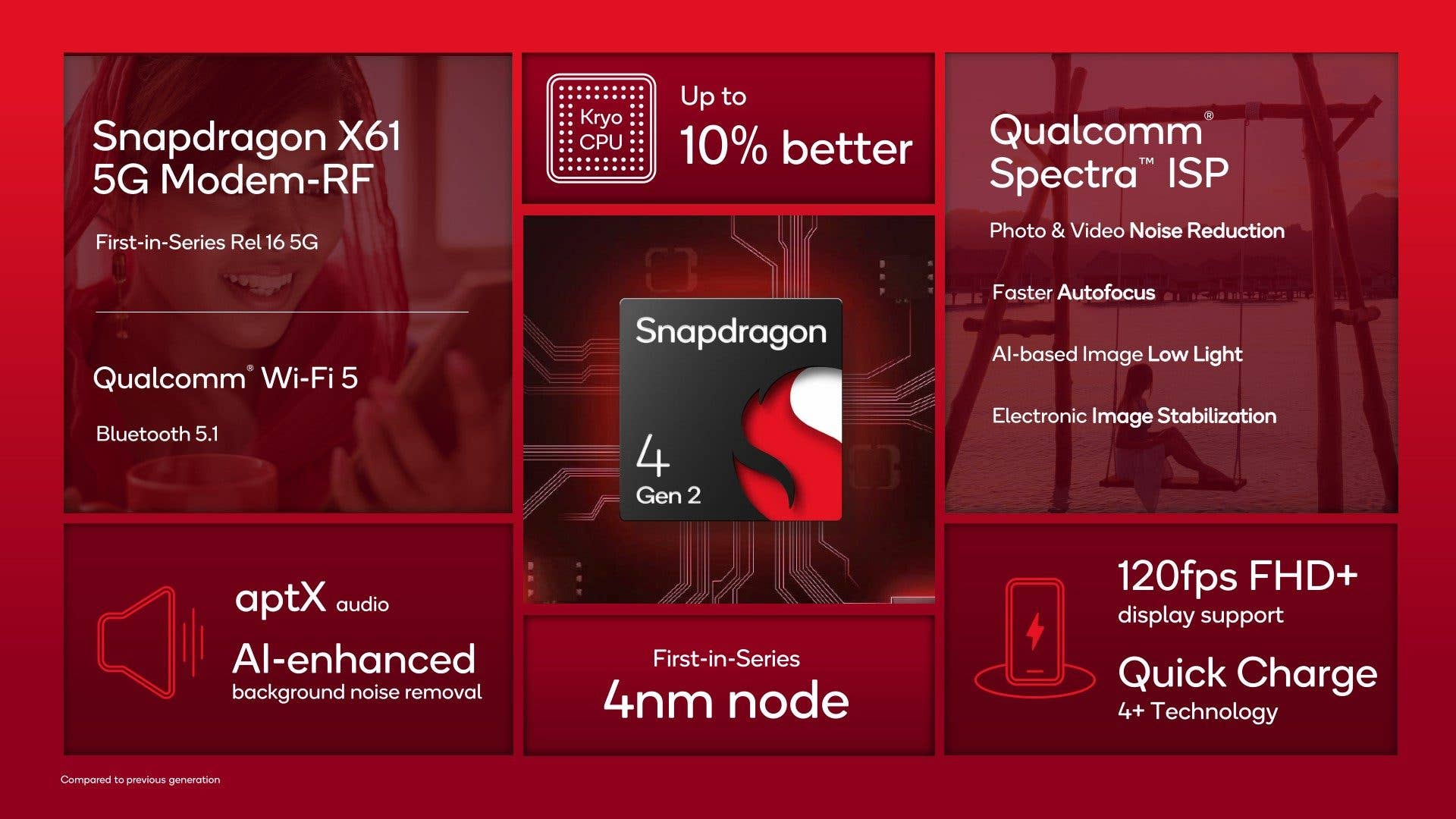
For connectivity, 5G support returns from the previous generation with the same theoretical links of up to 2500 Mbps. Wi-Fi support is also the same, with Wi-Fi 5 (11ac). Bluetooth, however, was downgraded from v5.2 to v5.1 on the Snapdragon 4 Gen 1 for undisclosed reasons.
The Snapdragon 4 Gen 2 is expected to launch on phones from Redmi and vivo in the second half of 2023, Qualcomm didn’t detail specific models, but all signs indicate we won’t have to wait long, with five days left to 2H2023.
Do you think it is time to retire 4G-only chips? Or do you think 5G still has yet to prove it’s usefulness? Share your point of view in the comments below!