Sorry, but there's really nothing to see here right now. Our server is in maintenance mode – and our
little bot is trying to sort the error messages with its last bit of energy.
Whether it was a data leak, a power outage in the cluster, or just a grumpy bit – we don't know yet.
But what we do know is:
The data drama escalated into a server meltdown. But don't worry: We're on it.
What now?
Everything is surely running smoothly over at our colleagues from inside
digital – why not stop by!
Or you could pass the time by visiting our social media channels – for example Instagram, YouTube or TikTok. At least there are no
server problems there – promised.
Thanks for your patience. Our bot is already rebooting at full speed. 🔧
NewsTabletGoogle Pixel 8a Benchmark Indicates a Restrained Nona-Core Processor
Google launched the Pixel 7a (review) a few months ago, but now we’re getting more details about its successor, the Pixel 8a. The latest sighting hailed from a benchmark listing, revealing the custom Tensor G3 chipset with a rather muted nona-core processor that will power the upcoming device.
Don’t miss this: The best premium smartphones you can buy for less than $600 in 2023
It is expected that the internet search giant will introduce the Google Pixel 8 and Pixel 8 Pro by October, and both are the first devices that will be equipped with the new Tensor G3 SoC. Unsurprisingly, this is the same silicon that will power next year’s Pixel 8a, which was recently spotted to carry the codename Google Akita.
Google Pixel 8a Tensor G3 processor benchmark scores
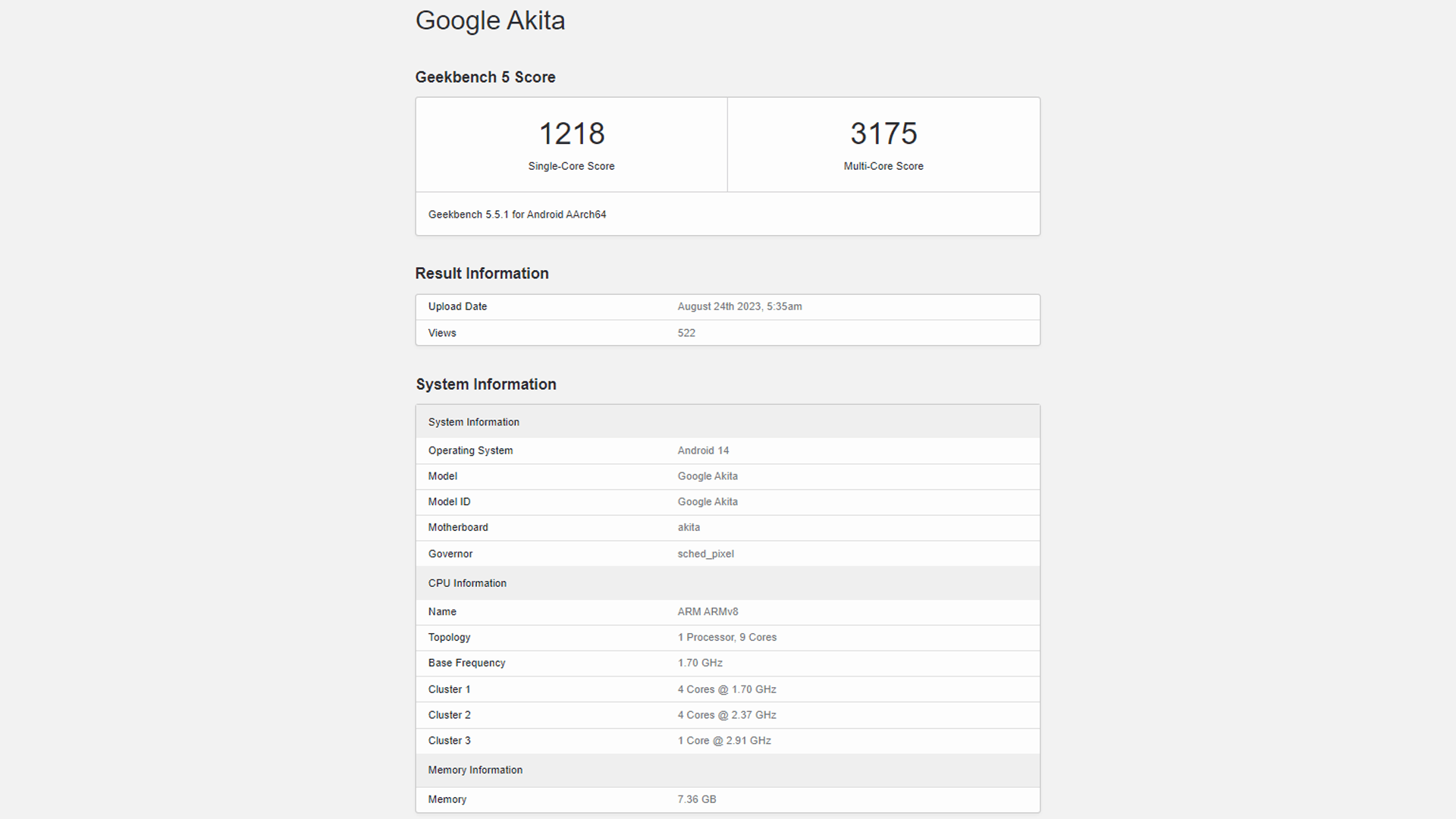
Regarding the chip’s performance, an early Geekbench 5 benchmark result showed the Pixel 8a was fitted with an underclocked Tensor G3. The nona-core CPU setup is apparently using a Cortex-X3 prime core clocked at 2.91 GHz coupled to four performance cores at 2.37 GHz and four efficiency cores, each at 1.7 GHz.
The slightly slower clock speeds of these cores could explain the relatively lower score of 1,218 for single-core and 3,175 for multi-core performance compared to a separate Tensor G3 benchmark. However, the listing does suggest this could still change in the future, with higher scores expected in the future. It is also unclear whether Google will opt for this configuration on the definitive Pixel 8a.
In comparison, the Tensor G3 which shares its architecture with Samsung’s Exynos 2400 SoC seems to be underperforming in multi-core benchmarks when pitted against the Snapdragon 8 Gen 2. To put things in perspective, the latter chip averaged 1,100 points in single-core and 4,800 in multi-core when tested on the OnePlus 11 (review). Regardless, it’s too early to make any definite conclusions until we review the actual device.
Alternatively, you can check our flagship mobile SoC guide on how the current chipsets from different brands stack up against each other.
In your opinion, how would you improve Google’s Pixel 8a? Would you like to see a telephoto camera added or perhaps a larger display? Tell us in the comments.
We mark partner links with this symbol. If you click on one of these links or buttons–or make a purchase through them–we may receive a small commission from the retailer. This doesn’t affect the price you pay, but it helps us keep nextpit free for everyone. Thanks for your support!








0 comments