

Contents
MediaTek has officially unveiled the Dimensity 9500s, the first of its kind in this series. It is a strategically binned version of the top-tier Dimensity 9500 that launched in September 2025. While certain areas of the chip have been slightly scaled back, it is specifically designed to power 2026’s affordable flagship devices, better known as flagship killers.
Following a trend similar to Qualcomm, MediaTek is using the “s” label to denote a more accessible silicon package achieved through fine-tuned adjustments in performance and features.
Powerful Performance in a More Efficient Package
The Dimensity 9500s utilizes the same All Big Core architecture with a 1 + 3 + 4 configuration. The primary core is headlined by the Arm Cortex-X925, clocked at 3.73 GHz. For comparison, the standard Dimensity 9500 uses the Arm C1-Ultra clocked at a higher 4.21 GHz.
However, what is sacrificed in raw clock speed is regained in the cache. The Dimensity 9500s features a massive 19 MB CPU cache alongside a 10 MB system cache. This total of 29 MB of on-chip memory helps maintain snappy performance and reduces latency. In real-world scenarios, the s-tier SoC should perform within 5 to 10% of the standard chip, a difference that is virtually unnoticeable to most users.
In terms of graphics, there is a more notable adjustment. The Dimensity 9500s is equipped with the Immortalis-G925 GPU featuring advanced hardware ray tracing. While its peak graphics performance is roughly 15% lower than the G1-Ultra in the flagship 9500, MediaTek notes that this results in much higher efficiency. This is ideal for sustaining high frame rates during long gaming sessions without thermal throttling or excessive battery drain.
MediaTek Dimensity 9500s Compared
| MediaTek Dimensity 9500s | MediaTek Dimensity 9500 | Qualcomm Snapdragon 8 Elite Gen 5 | Qualcomm Snapdragon 8 Elite | Samsung Exynos 2500 | Google Tensor G5 | MediaTek Dimensity 9400 | |
|---|---|---|---|---|---|---|---|
| Prime core | 1x Cortex-X925 @ 3.73 GHz | 1x ARM C1-Ultra @ 4.21 GHz | 2x Oryon @ 4.6 GHz | 2x Oryon @ 4.32 GHz | 1x Cortex-X925 @ 3.3 GHz | 1x Cortex-X4 @ 3.78 GHz | 1x Cortex-X925 @ 3.62 GHz |
| Performance core | 3x Cortex-X4 @ 3.3 GHz | 3x ARM C1-Premium @ 3.5 GHz | 6x Oryon @ 3.62 GHz | 4x Oryon @ 3.53 GHz | 2x Cortex-A725 @ 2.75 GHz 5x Cortex-A725 @ 2.36 GHz | 5x Cortex-A725 @ 3.05 GHz | 3x Cortex-X4 @ 3.3 GHz |
| Efficiency core | 4x Cortex-A720 @ 2.4 GHz | 4x ARM C1-Pro @ 2.7 GHz | 2x Cortex-A520 @ 1.8 GHz | 2x Cortex-A520 @ 2.25 GHz | 4x Cortex-A720 @ 2.4 GHz | ||
| RAM | LPDDR5x-9600 | LPDDR5x-10667 4x 16-bit @ 5333 MHz (85.4 GB/s) | LPDDR5x-10600 4x 16-bit @ 5300 MHz (84.8 GB/s) | LPDDR5x-10600 4x 16-bit @ 5300 MHz (84.8 GB/s) | LPDDR5x | LPDDR5x | LPDDR5x-10667 4x 16-bit @ 5333 MHz (85.4 GB/s) |
| GPU | 12x ARM Immortalis-G925 @ 1.6 GHz | 12x ARM Mali G1-Ultra @ 1.7 GHz (5271 GFLOPs) | Adreno @ 1.2 GHz | Adreno 830 @ 1.1 GHz (3379 GFLOPs) | AMD Radeon RDNA2 @ 1 GHz (4091 GFLOPs) | PowerVR DXT-48-1536 (1536 GFLOPs) | 12x ARM Immortalis-G925 @ 1.6 GHz (4952 GFLOPs) |
| 5G modem | MediaTek (7/3.5 Gbps) | MediaTek | Snapdragon X85 (12.5/3.7 Gbps) | Snapdragon X80 (10/3.5 Gbps) | Exynos (12.1/3.6 Gbps) | Exynos 5400i | MediaTek (7/3.5 Gbps) |
| Connectivity | Wi-Fi 7 Bluetooth 5.4 Auracast | Wi-Fi 7 Bluetooth 6.0 | FastConnect 7900 Wi-Fi 7 Bluetooth 6.0 UWB | FastConnect 7900 Wi-Fi 7 Bluetooth 6.0 UWB | Wi-Fi 7 Bluetooth 5.4 | Wi-Fi 7 Bluetooth 6.0 | Wi-Fi 7 Bluetooth 5.4 |
| Process node | TSMC N3E | TSMC N3P | TSMC N3P | TSMC N3E | Samsung 3GAP | TSMC N3 | TSMC N3E |
The chipmaker has also optimized the NPU for modern AI workloads, specifically real-time agentic tasks and on-device content generation. While an official TOPS rating was not disclosed, it is positioned to sit above the 50 TOPS of the previous generation.
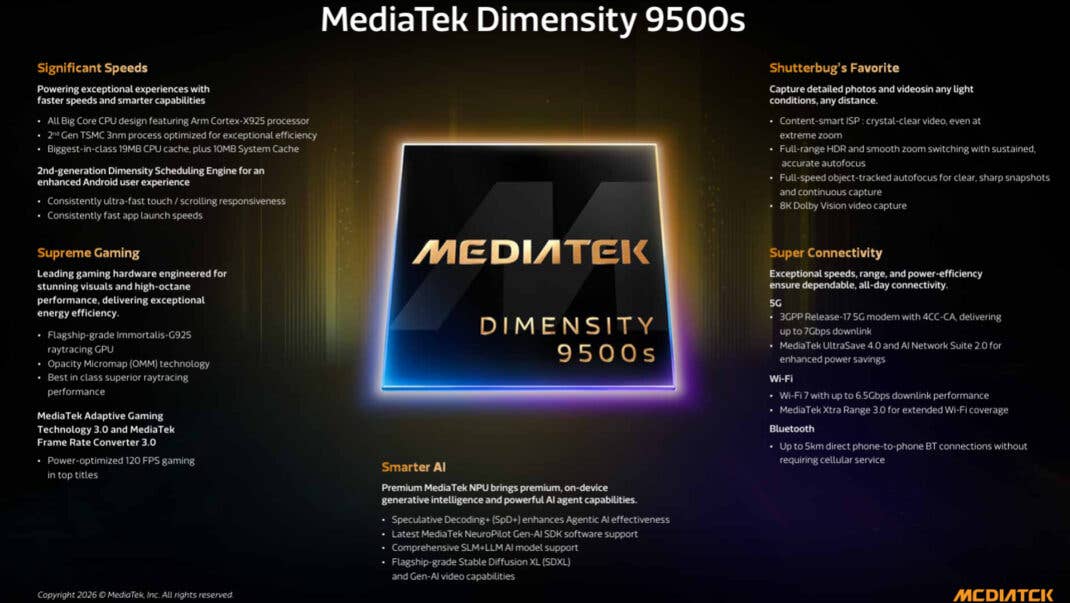
Elsewhere, the Dimensity 9500s supports UFS 4.0 storage and features the advanced MediaTek Imagiq image processor, which enables 8K video recording and faster noise reduction. Connectivity is a major highlight, with Wi-Fi 7, Bluetooth 5.4, Auracast support, and 5G download speeds reaching up to 7 Gbps.
Flagship Phones for Less
The Dimensity 9500s is expected to appear in budget flagships and premium mid-range devices. Given the negligible performance difference, this chip is a perfect fit for users who want premium power without spending $1,000 or more on a flagship.
Xiaomi has confirmed that its upcoming Redmi Turbo 5 Max will be among the first to feature the Dimensity 9500s. This device is expected to arrive in global markets as a new Poco smartphone. Reports also suggest that both OnePlus and Oppo are preparing smartphones equipped with this new chip.
Mid-Range Phones are Getting Better
In addition to the 9500s, MediaTek also unveiled the mid-range Dimensity 8500. While it is technically a refresh of the 8400, it offers higher clock speeds on its eight-core Cortex-A725 architecture and supports faster LPDDR5X memory. The GPU has also been upgraded to the newer Mali-G720, which provides a 25% uptick in performance over the previous generation.
Successors to the Xiaomi 15T and Poco X7 Pro are likely candidates for this new chipset, though these brands may offer slightly enhanced versions to differentiate their models.
Are you planning to upgrade your smartphone this year? Or are you skipping the 2026 cycle due to potential price hikes? We want to hear your plans in the comments.
We mark partner links with this symbol. If you click on one of these links or buttons–or make a purchase through them–we may receive a small commission from the retailer. This doesn’t affect the price you pay, but it helps us keep nextpit free for everyone. Thanks for your support! Prices are based on the date of publication of this article and may be subject to change.