

Contents
- 1 Design of the S26 Ultra: More uniform, calmer – but not perfect
- 2 Display: The Galaxy S26 Ultra stands out visibly
- 3 OS and AI functions: Samsung is building an AI ecosystem
- 4 Camera: Strong basis, known weaknesses
- 5 Processor: More than enough power
- 6 Battery: Finally faster on the Ultra
- 7 Initial assessment: Evolution with a clear focus
We were able to try out all three models for an afternoon. And even though the Ultra takes center stage as expected, many of the new features we are talking about here affect the entire series.
Design of the S26 Ultra: More uniform, calmer – but not perfect
Samsung is bringing clear visual consistency to the Galaxy S range for the first time in years. The S26, S26+, and S26 Ultra now all follow the same design line with a flat front and back and rounded corners.
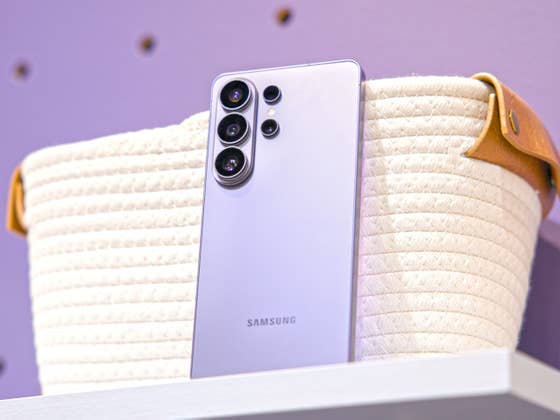
The most striking change is the new camera unit. Instead of individual lenses attached to the housing, the cameras now sit on a shared island. On the S26 and S26+, this results in a harmonious overall look. On the Ultra, the integration is less elegant: the additional telephoto lens and the autofocus sensor are somewhat lost next to the main camera unit. Of course, this doesn’t matter from a functional point of view, but Samsung could have done a cleaner job aesthetically.
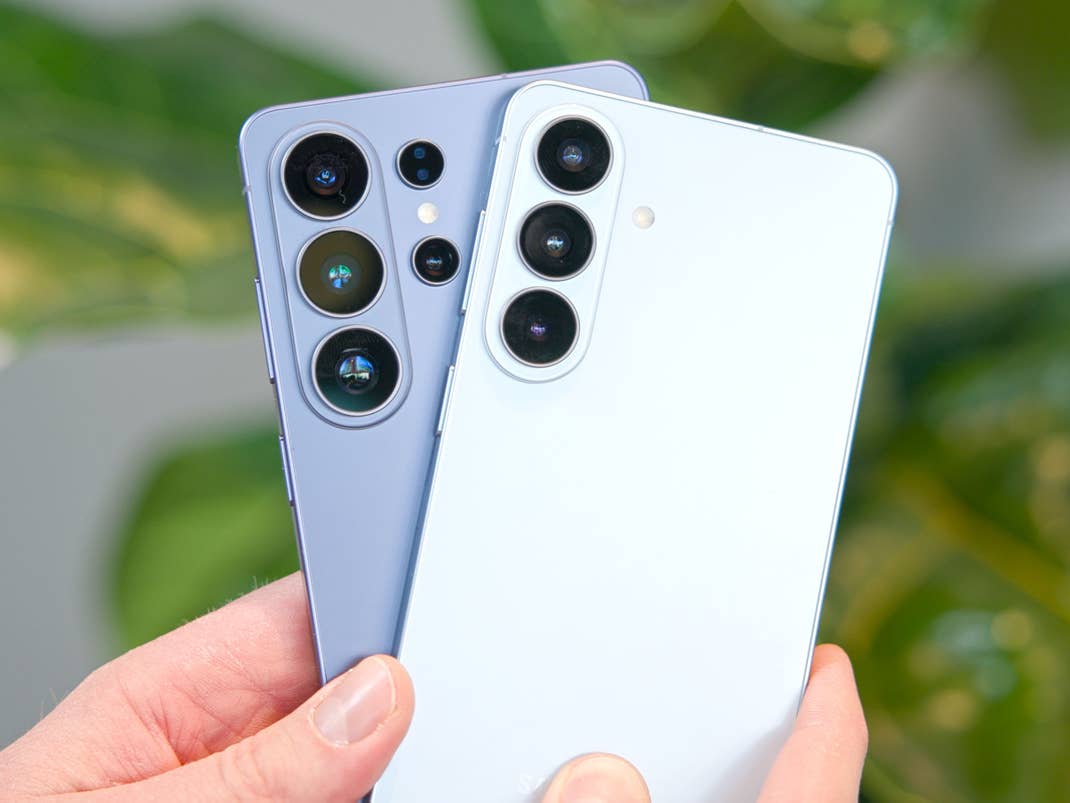
The material quality corresponds to the expected flagship level. All devices feel extremely stable and high-quality. Samsung also uses Gorilla Armor 2 over the display on all models. The Ultra remains the only model with an integrated S-Pen. The stylus works reliably and precisely as usual, but has no new functions.
Overall, the S26 series looks more mature and consistent. The design is not revolutionary – but it is finally clearer.
Display: The Galaxy S26 Ultra stands out visibly
The hierarchy within the series is clearly evident in the displays. All three devices use high-quality Dynamic AMOLED panels with FHD+ (2340×1080 pixels, S26) or QHD+ (3120×1440 pixels, S26+ and S26 Ultra). All panels achieve a 120 Hz refresh rate, look great, and offer high brightness. However, the Ultra has two features that clearly set it apart from the rest.
Firstly, it once again has a low-reflection display. Compared with the S26 or S26+, the Ultra is immediately noticeably less reflective. This noticeably improves readability, especially in bright ambient light. Content appears richer in contrast, black levels are deeper, and the overall picture is smoother.
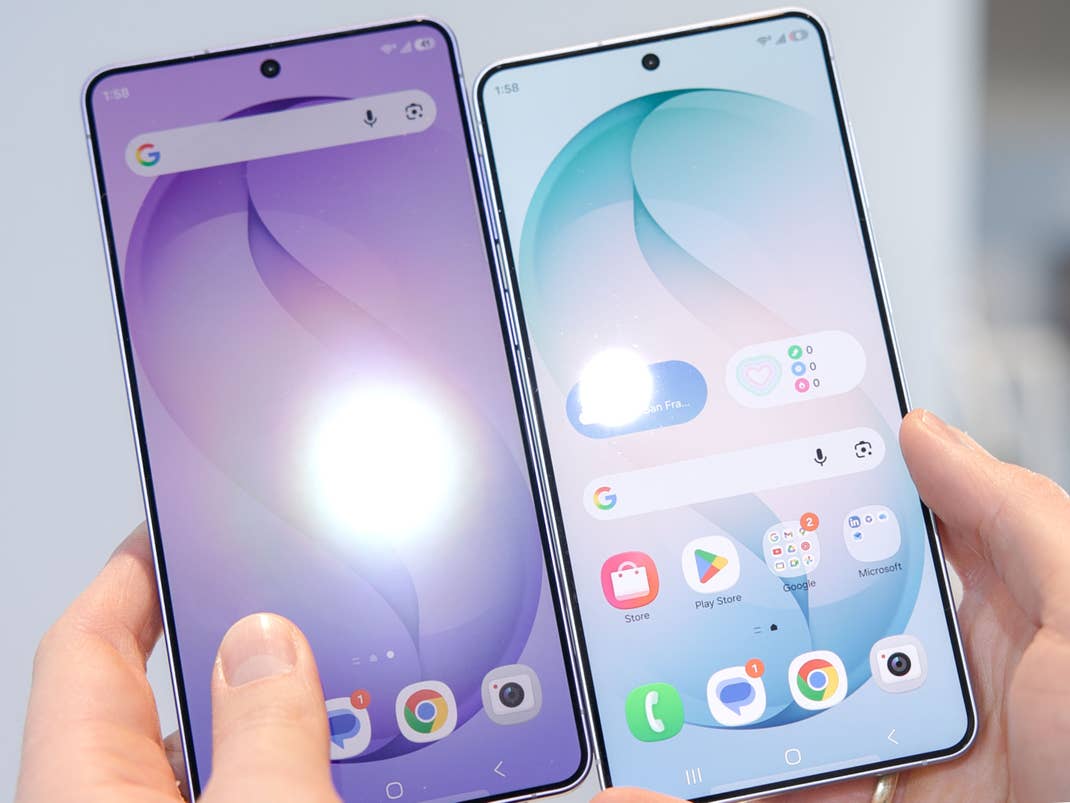
Samsung is also introducing a new privacy mode. This specifically deactivates the OLED pixels with a wide viewing angle. The result: from the front, the display remains bright and clear, but from the side, the contrast and colors tilt significantly. The effect is reminiscent of older LCD panels with weak viewing angles – only this time it is used deliberately.
The mode can be configured quite granularly. You can specify which apps it applies to or when it should be active. And it’s particularly cool: The privacy display can also be activated for individual screen areas, for example, for pop-up notifications, which then appear black from the side. All in all, this practically prevents the people sitting next to you on the train or plane from reading along. Only a location-based activation would be nice.
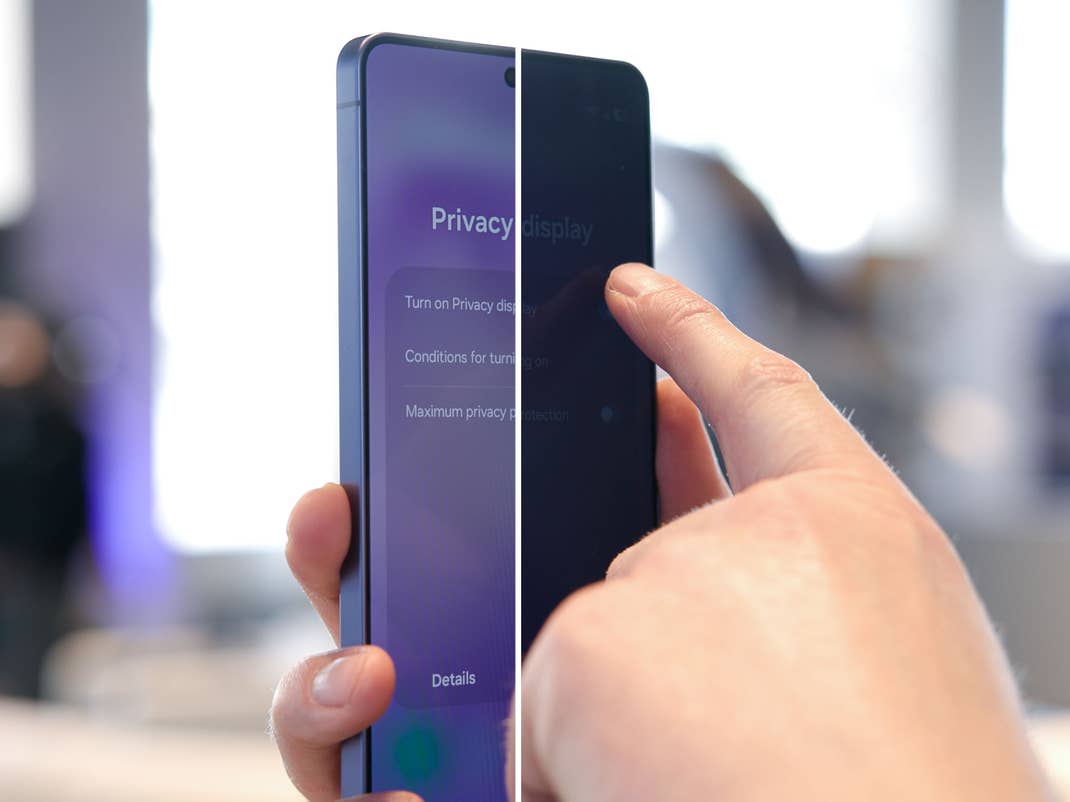
Overall, Samsung delivers one of the best and most innovative smartphone displays of the year – especially in the Ultra.
OS and AI functions: Samsung is building an AI ecosystem
The biggest change in the S26 series is not in the design or the camera, but in the operating system. Samsung continues to drive forward the integration of AI features, most recently with the partnership with Perplexity – but more on that in a moment.
Many functions run directly on the device. This results in lower latency, better data protection options, and offline capability. One example is the new image editing in the gallery. Photos can now be edited directly via a prompt; you can add objects or change the background, for example. Processing takes place locally but always introduces a noticeable pause. The results seem surprisingly good at first glance, but still have to hold their own against competitors such as Nanobanana & Co. in an extensive test.
Another new feature is a screenshot analyzer. Anyone who regularly saves screenshots will be familiar with the chaos in the gallery. The system automatically recognizes content and organizes screenshots into categories such as location, social media, shopping, or events. Content can then be searched through specifically or found again, depending on the context. This is probably one of the most underrated features, especially for power users.
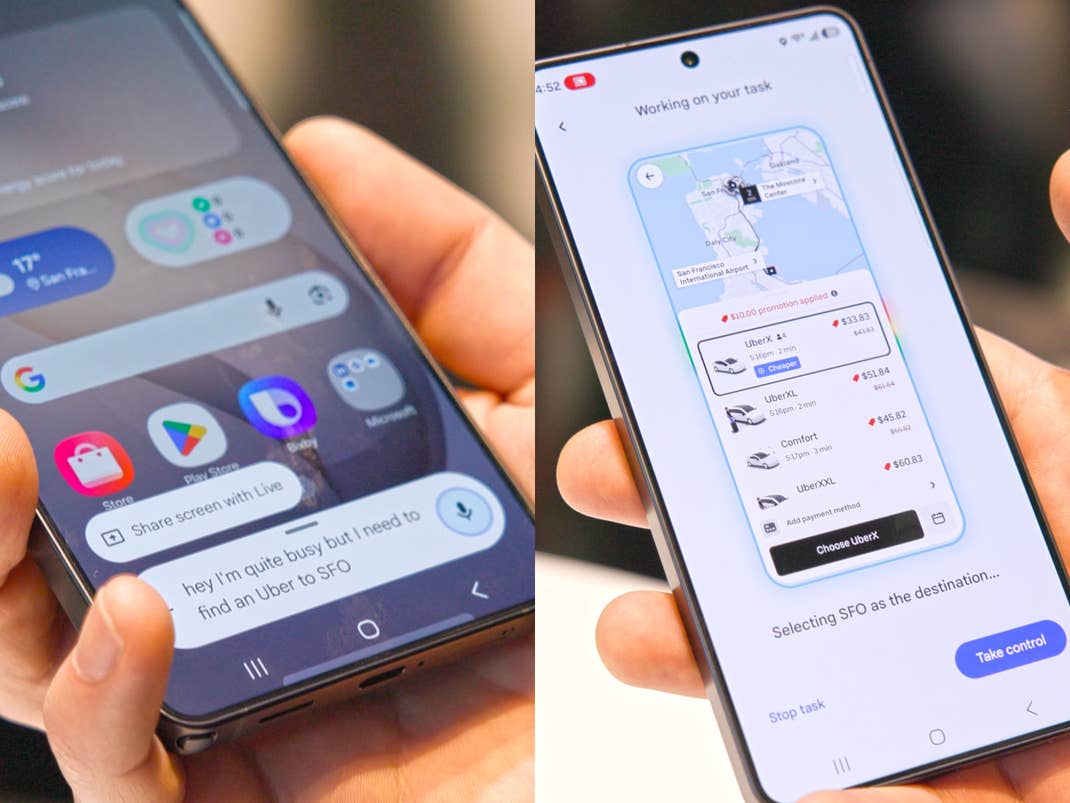
Samsung is also moving toward more agent-based assistance. In the future, the AI will also be able to search through calendars, messages, and emails to prepare tasks. For example, if you want to book a ride to an appointment, you don’t need to have the address on hand as long as it is stored in your calendar. Unfortunately, the feature could not yet be activated on the devices we had available for testing.
The AI strategy itself is also exciting – and somewhat overwhelming. Samsung is integrating several systems in parallel: Perplexity for research, Gemini for generative and practical tasks, and Bixby for device control. In everyday life, however, the user should not have to constantly switch between individual AI systems; instead, the smartphone should automatically determine which AI is most useful for a task.
A small but clever innovation is “Now Nudge”. When typing in messaging apps, context-based suggestions appear above the keyboard, such as calendar links or notifications about appointment conflicts. This acts like an intelligent layer over the entire system and can really save time and nerves in everyday life.
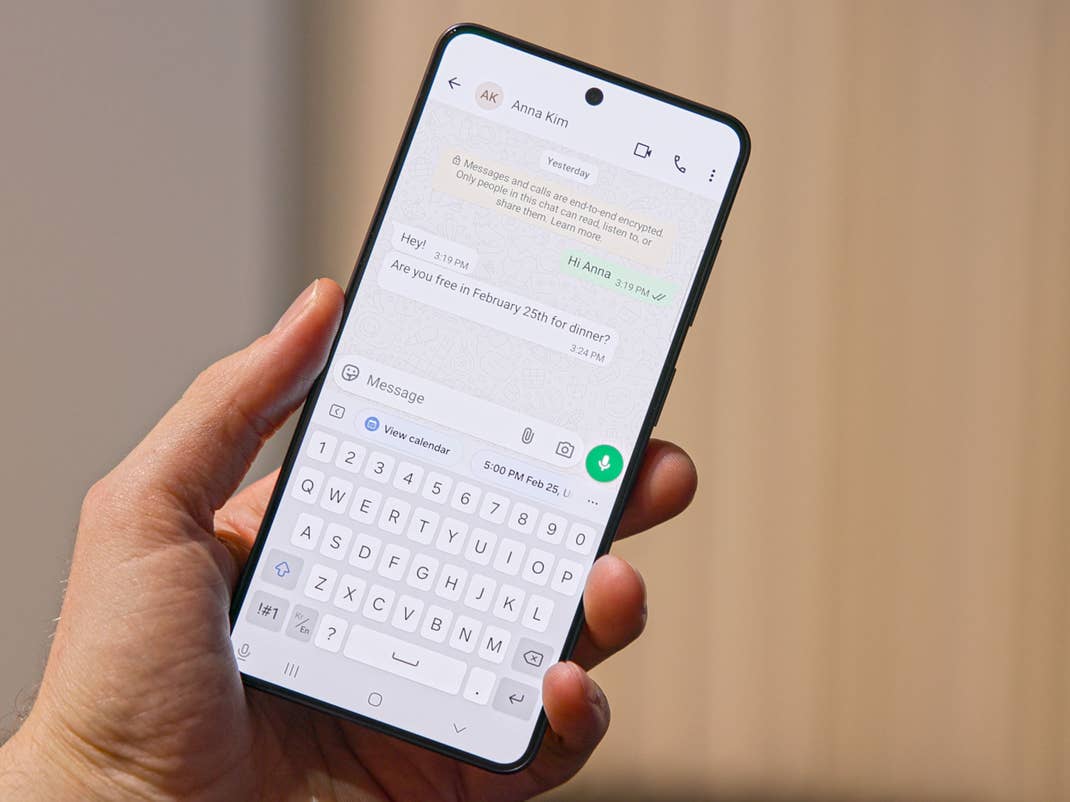
There are also functions such as an audio eraser for video content from YouTube, Netflix, etc., an AI call assistant for unknown numbers, and an improved document scanner. Not everything is revolutionary, but the result is a very dense AI ecosystem.
Camera: Strong basis, known weaknesses
Samsung is focusing on continuity with the camera. This applies in particular to the S26 and S26+, which essentially continue the familiar hardware of their predecessors. There are again three sensors: 50, 12, and 10 megapixels, for the main camera, ultra-wide-angle, and 3x telephoto cameras.
The Ultra remains the flagship camera. The main camera with 200 megapixels is supported by two 50-megapixel sensors for ultra-wide-angle and 5x telephoto. There is also a 3x zoom camera – and this is where the problem lies. This sensor is significantly weaker than the other modules. This results in a noticeable quality gap between 3x and 4.9x magnification.
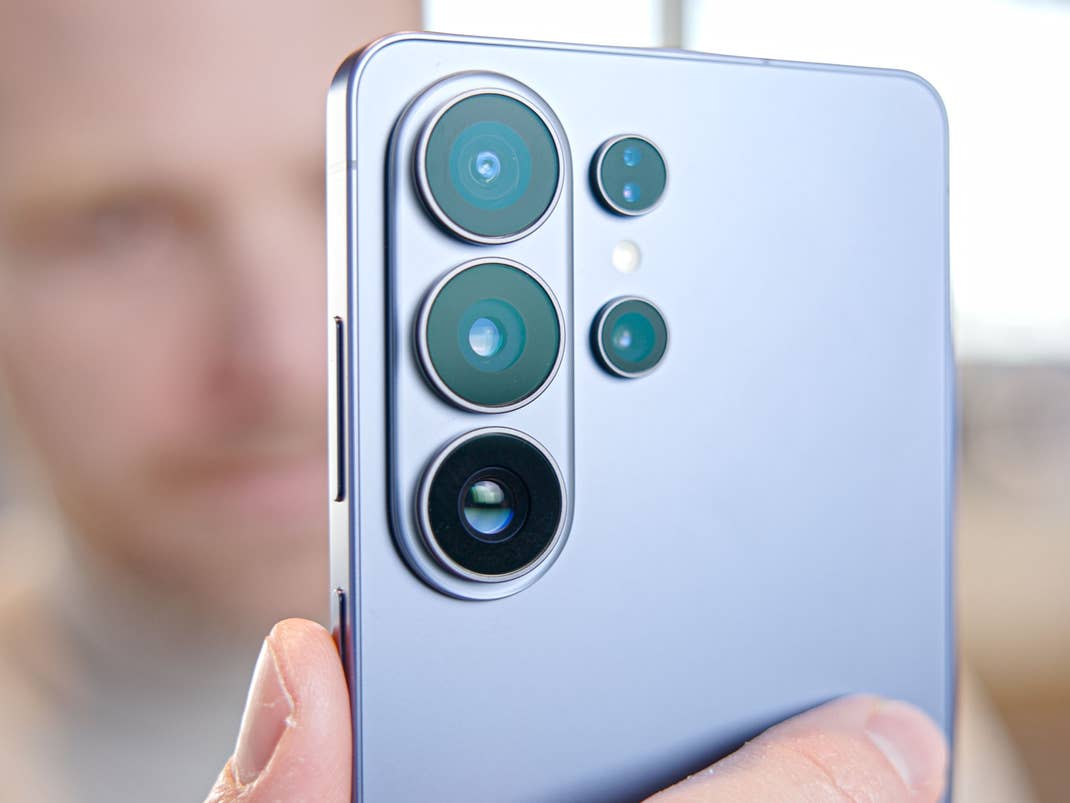
Samsung has also significantly improved the light intensity of some lenses, but everything remains the same with the 3x zoom. In purely mathematical and practical terms, this is the camera system’s biggest weakness. Especially in comparison to aggressive developments by Chinese manufacturers, Samsung seems a little too conservative here.
On the other hand, there are interesting innovations in the video area. A new feature called “Horizontal Lock” keeps the image section in a stable horizontal position, even if you turn the smartphone wildly during recording, for example, because you are running with the smartphone in your hand or even accidentally switch from portrait to landscape format while filming.
Overall, the camera quality of the S26 series remains very high. Unfortunately, however, there is no real leap in hardware.
Processor: More than enough power
Under the hood, Samsung has once again opted for a two-chip strategy. The S26 and S26+ use the new Exynos 2600, while the Ultra is equipped with a higher clocked “for Galaxy” version of the Snapdragon 8 Elite Gen 5.
In everyday use, the performance difference should hardly be noticeable to most of you. All three devices respond extremely quickly, launch apps without delay, and handle demanding AI functions and games without issue. The Ultra theoretically offers more reserves, but even the basic version already seems more than sufficient.
It will be interesting to see how the different chips affect efficiency and battery life. This cannot yet be definitively assessed in the hands-on.
Battery: Finally faster on the Ultra
Speaking of the battery: Samsung has made small but important advances in charging. The S26 Ultra now supports up to 60 watts and should reach around 75 percent in around 30 minutes. This means that Samsung has clearly overtaken its biggest rival, Apple, but many Chinese Android manufacturers remain significantly faster.
The S26 and S26+ are more conservative overall. They still offer 25 and 45 watts, respectively. Wireless charging is 25 watts for the Ultra and Plus, and 15 watts for the base model. That’s solid, but also not exhilarating. Let us know in the comments how much charging power you would expect from a current cell phone.
Initial assessment: Evolution with a clear focus
The Galaxy S26 series is not a radical new start. The design and camera continue to develop cautiously, but there are no real hardware revolutions. Instead, Samsung is clearly shifting the focus towards AI, display technology, and system integration.
The Ultra remains the most exciting model – primarily because of the display and the new AI functions. At the same time, the S26 and S26+ also benefit from the new software approach. Anyone expecting a classic hardware upgrade may be disappointed. Those who want to see where smartphones are heading as personal assistance systems will get a very interesting outlook here.
The detailed test will show whether this is enough to hold its own against the increasingly strong competition from China, and we are also expecting one or two other innovations around the MWC in Barcelona.