Sorry, but there's really nothing to see here right now. Our server is in maintenance mode – and our
little bot is trying to sort the error messages with its last bit of energy.
Whether it was a data leak, a power outage in the cluster, or just a grumpy bit – we don't know yet.
But what we do know is:
The data drama escalated into a server meltdown. But don't worry: We're on it.
What now?
Everything is surely running smoothly over at our colleagues from inside
digital – why not stop by!
Or you could pass the time by visiting our social media channels – for example Instagram, YouTube or TikTok. At least there are no
server problems there – promised.
Thanks for your patience. Our bot is already rebooting at full speed. 🔧
ReviewsMeta Quest Pro review: Discounted price makes it a bargain!
The Meta Quest Pro is currently the most advanced standalone VR glasses on the market, at least until Apple finally makes the “Apple Reality One” or “Apple Reality Pro” mixed reality headsets the official must-have device for every household. Until then, Mark Zuckerberg’s all-in-one headset remains the industry’s plumb line. Having arrived at the NextPit editorial offiice and bringing out colleagues on a virtual reality adventure, here is out detailed review of Meta’s all-in-one VR headset.
With the Oculus Quest and Quest 2 (later renamed as the Meta Quest 2), the former Facebook company gave us the feeling that virtual reality would remain affordable even with all-in-one headsets. However, the Meta Quest Pro, which was announced as much lighter, should already burst this utopian bubble.
Since December 9, the “professional” Meta Quest can be purchased worldwide for $1,499.99 (12/256 GB). But wait, what is this? Mark Zuckerberg has reduced the price of the Meta Quest Pro by a whopping $500 on March 15, 2023!
We do not have any issued statement on why the price has been slashed to $999. It only mentioned that they want to make the “industry-leading meta reality technology and optical stack from the ‘Infinite Display’ available to even more businesses and professionals around the world,” which is basically marketing drivel.
Basically, it can be assumed that Meta has taken note of the HTC Vive XR Elite’s launch price of $1,099. Based on my Meta Quest Pro review, the VR/XR goggles are the better choice, even though they are more expensive.
Basically, the Meta Quest Pro offers somewhat identical technical specifications and features as the Meta Quest 2 we reviewed, so all VR applications and games of the Quest 2 are playable. However, there are also some applications that have been optimized for the hand, eye, and face tracking of the Meta Quest Pro. This is where, in addition to the significantly slimmer headset, the wheat is separated from the chaff.
Meta views the primary clientele for the Pro model to lean more toward the corporate and medical sectors than VR gamers. Therefore, the company will introduce the Meta Quest 3 this fall. The $1,099 standalone VR goggles can be viewed as a different kettle of fish from that point of view.
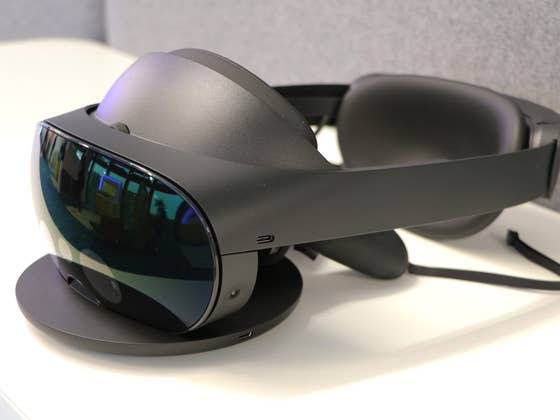
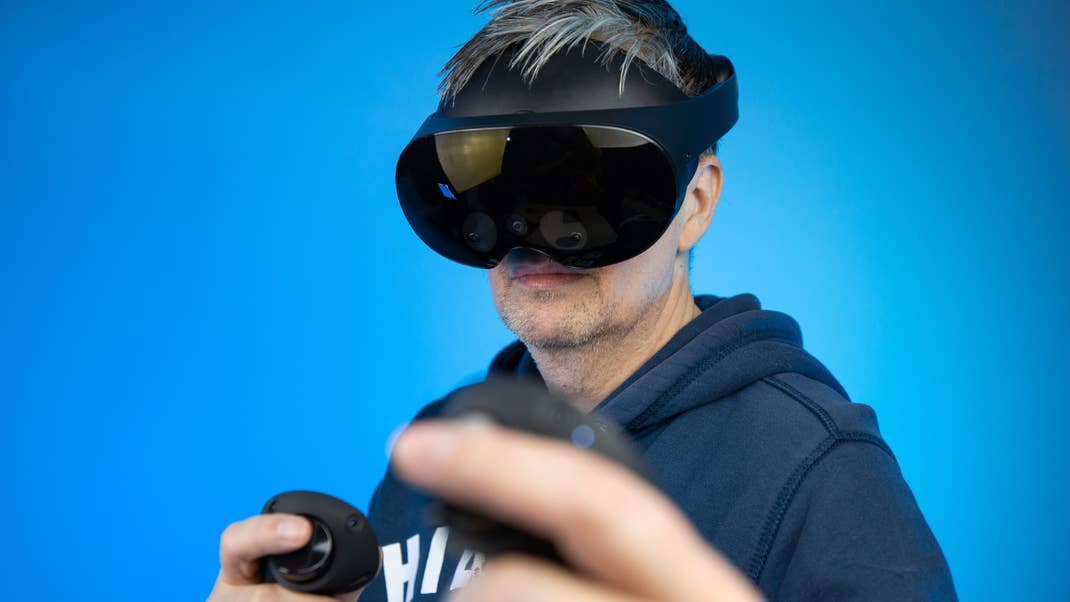
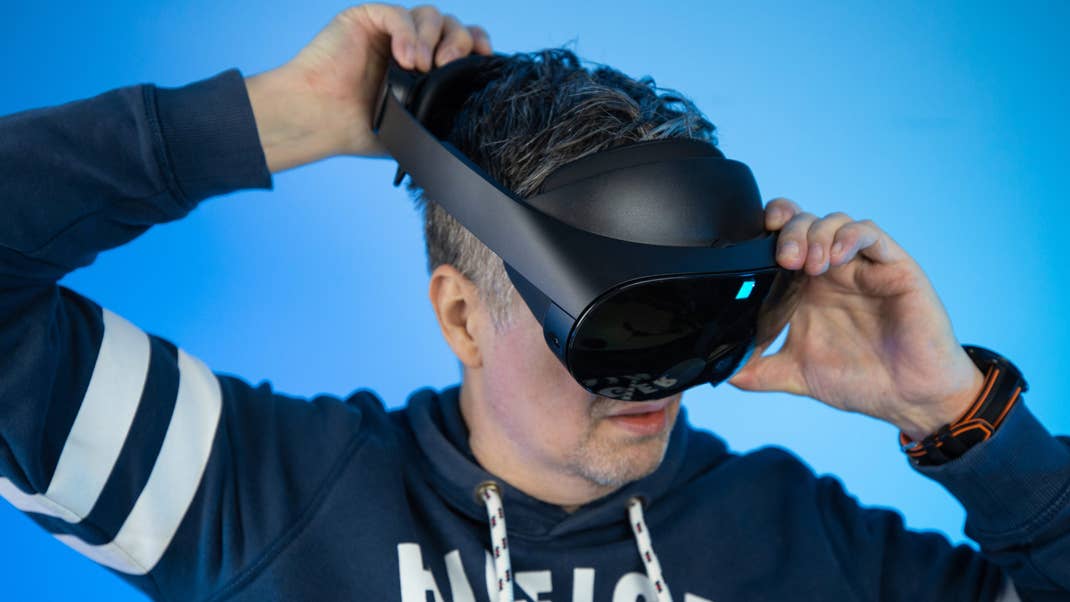
Yes—the Meta Quest Pro is significantly slimmer and more ergonomically built compared to the Quest 2 . It looks a bit like a pair of ski goggles and is less boxy around the nose, unlike the Quest 2. However, the scales show a whopping 722 grams compared to the Quest 2’s 503 grams when weighed. It must be all the ‘muscle’, right?
Not really, the additional weight is attributed to the rear “head strap” where the battery is installed and ensures a much better wearing comfort. I subsequently purchased the same accessory for the Quest 2, which saw the “cheaper” standalone VR glasses increase in weight all the way to 670 grams.
What I liked:
Significantly more complicated than the Meta Quest 2.
Pancake lenses.
RGB passthrough supported.
Lateral light blockers.
What I disliked:
Missing head strap.
It is not so light, either.
Long gaming sessions tend to place pressure on the forehead.
An average gaming session revealed that the 265 x 127 x 196 mm Pro has superior wearing comfort compared to the Quest 2. However, prolonged gaming with the new VR goggles is not necessarily a comfortable experience, either. Nevertheless, the forehead mount seemed to be a bit too narrow to me with not enough padding. The forehead padding tends to press in with pressure over time, which raises the question of why is there not a strap on the head for added stability?
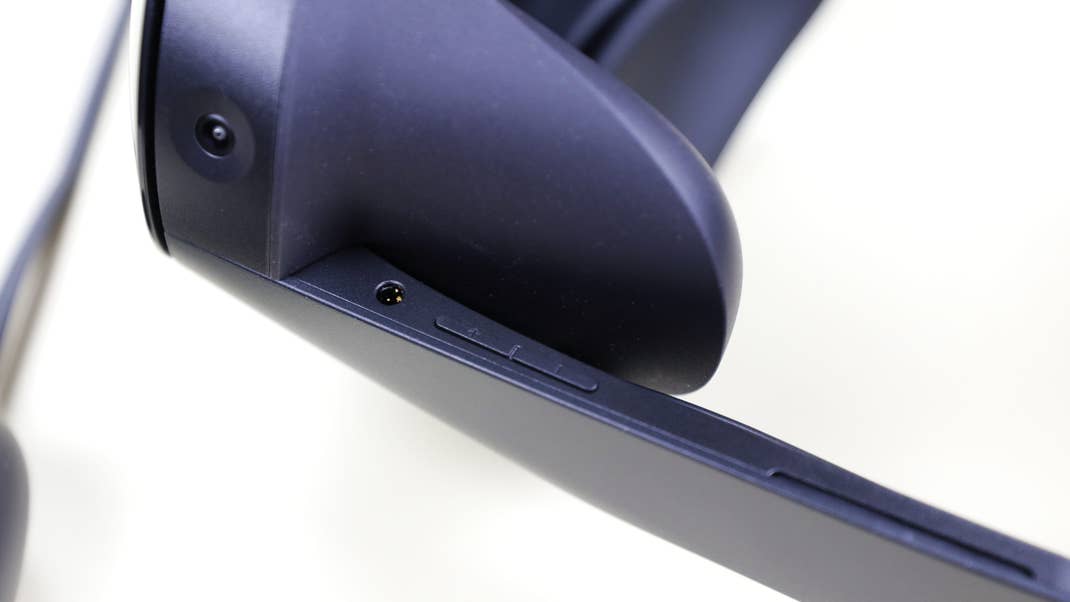
However, the magnetically locked lateral light blockers are very pleasing, isolating yourself from your surroundings very well. The stereo speakers, volume, and power buttons are located in the lateral temples. While the audio quality is sufficient, you can hear in greater detail via a pair of headphones connected through the headphone jack. The buttons are quite discreet and require a bit of practice and a good sense of touch to locate them based on your intuition.
At the back lies an adjusting wheel that can be used to tighten or loosen the headset. The front area, including the pancake lenses and cameras, cannot be raised, so those who wear prescription glasses will have to be careful. There is no dioptric correction here as found on the Vive Elite.
The display
Meta installed a pair of pancake lenses, where each of which come with a 1,920 x 1,800 pixels resolution at 72 or 90 Hz refresh rate per eye. Yes, you read it correctly – this is slightly less than the Meta Quest 2 (review) and considerably less than ByteDance’s Pico 4 (2,160 x 2,160). But said lenses offer an equally sharp image without a sweet spot across the entire 106-degree field of view horizontally (96° vertically).
If I did not know any better, I would assume it to be an OLED panel due to the good contrast, colors, and black values. However, just like the competition, there are only two LCDs.
Meta Quest Pro in use
The Meta Quest Pro and both controllers should be fully charged before their first use. Once that is fully taken care of, then the rest of the setup can begin. If you already own a Meta Quest 1 or 2, it is going to be easy for you, since you only have to enter existing data. New users will be asked to set up a Meta account. Yup, you read that correctly, the problem of forcing you to own a Facebook account no longer exists. Hence, the setup process can be completed in a relatively quick time.
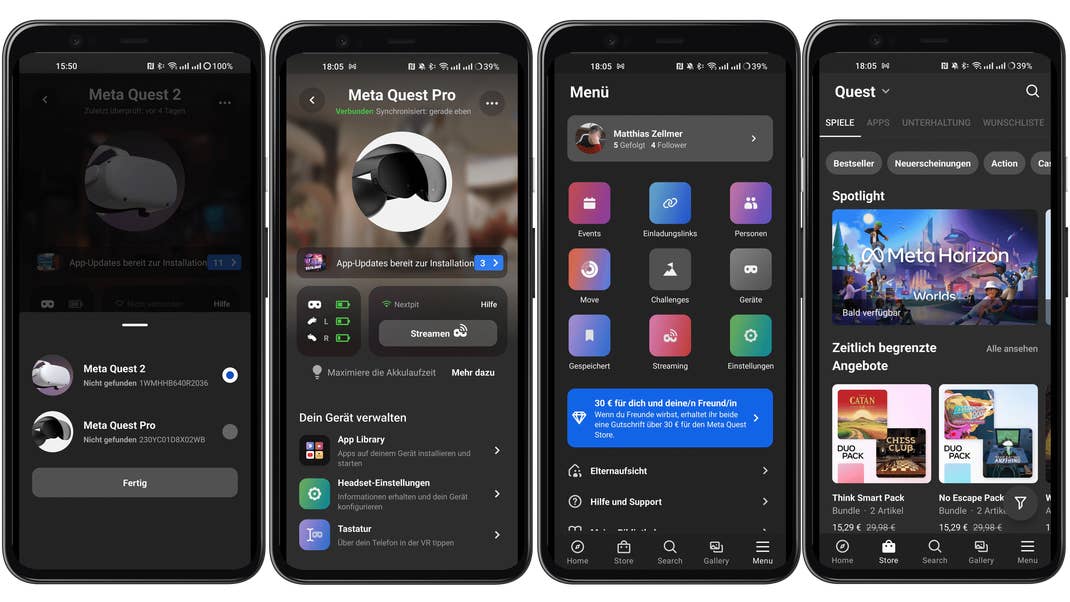
Meta still encourages you to install the free Meta Quest app from the Apple App or Google Play Store on your smartphone and connect it to the VR headset via WLAN and Bluetooth. Not only can you manage both apps and friends, you can also watch and even record the content via streaming.
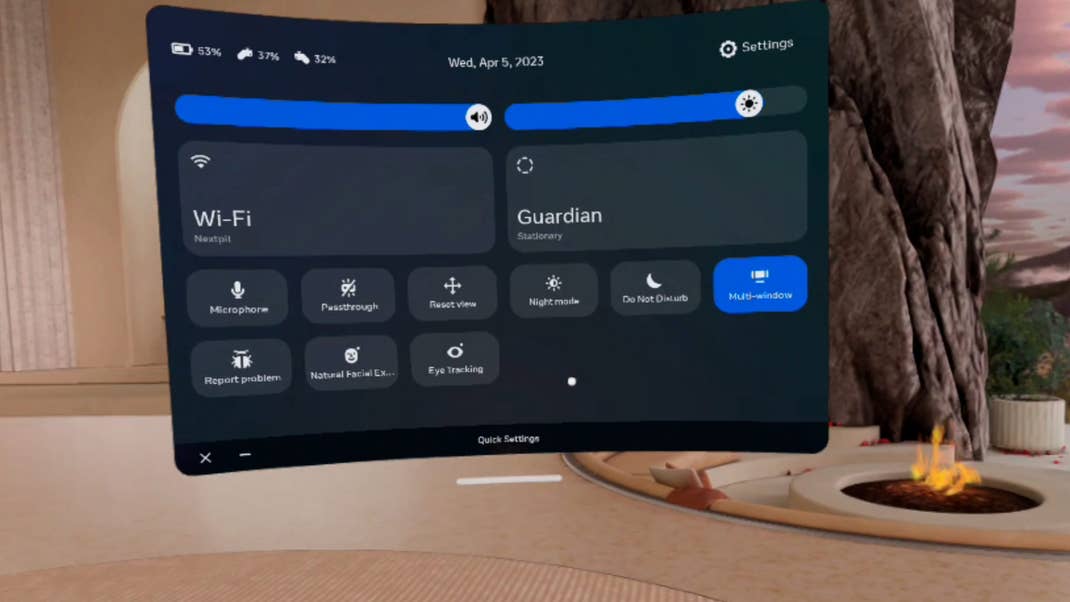
To quickly set up the gaming area, there are 2 practical steps: a stationary one and the so-called “roomscale”. The latter should offer a space of at least 2 × 2 meters. Obstacles should be removed beforehand. You are then required to specify the floor height with the controller and draw in your playing area.
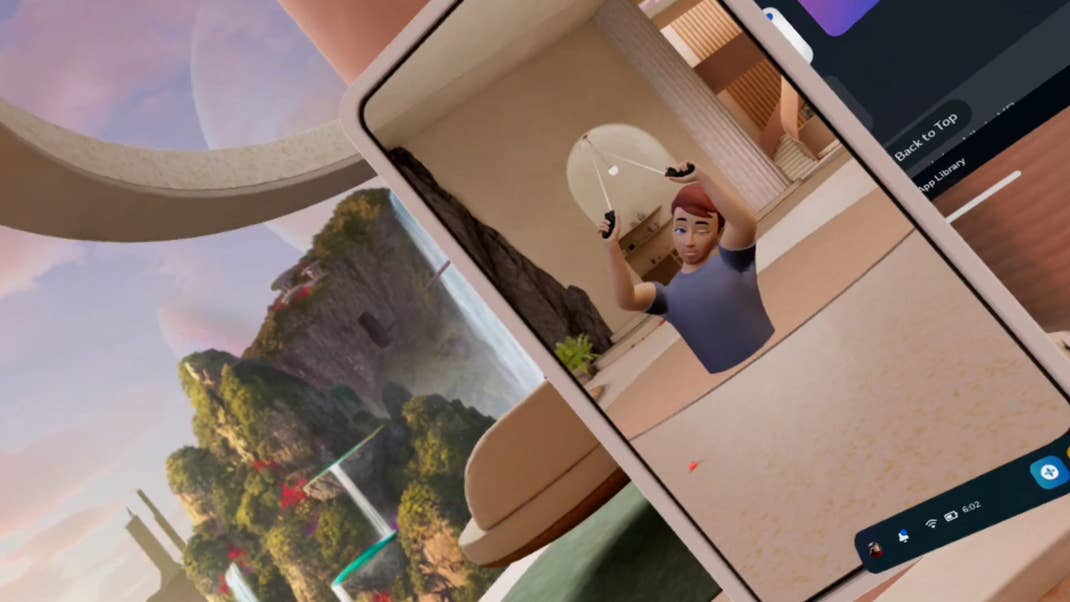
I was surprised that there is no special calibration process for the additional eye and face tracking. They can only be enabled or disable. Presumably this was done to save on battery capacity, because face tracking is primarily used in social apps like Horizon Workrooms, Immersed or Arkio, where an avatar is also used. Thus, it is simply not needed around the clock.
Does the face and eye tracking work? Short answer: yes. But it does take significant facial contortions for your counterpart to recognize a semblance of your facial expressions. If you’re having a normal conversation, they’ll only recognize simple lip twitches. But hey, we’re still at the very beginning of the VR revolution. Another station was dedicated to hand tracking, which seems to be much further along in its development than the Quest 2 realizes. This can be primarily attributed to the new controllers which are also compatible with the Meta Quest 2.
The Meta Quest Pro also has a so-called RGB passthrough mode, which is automatically enabled as soon as you leave the drawn-in room scale. Tapping twice on the goggle’s case also turns the passthrough feature on and off, provided it was programmed that way in the settings. This means that the built-in camera projects your physical surroundings onto the display. Here, too, the Meta Quest Pro has to be compared to the HTC Vive XR Elite, which unfortunately places the Quest Pro in a worse position.
The picture quality is quite satisfactory with a decent depth representation. Where it is lacking would be the representation of a display from a monitor, laptop or smartphone. HTC’s glasses are miles ahead in quality here.
Meta Quest Pro performance
Meta is the only manufacturer to install a Snapdragon XR2+ Gen 1 in the Quest Pro. The funny thing is, no one really wants to show what the octa-core processor manufactured in a 7 nm structure width is capable of.
What I liked:
Fast processor.
Sufficient memory.
What I disliked:
–
All that can be heard from Qualcomm is that the Snapdragon XR2+ Gen 1 performs state-of-the-art interactions with 50 percent higher continuous performance compared to the previous generation. Experts suspect a prime core that has an increased clock speed, up from 2.84 GHz to 3.2 GHz, doing all the hard work. Fabian Nappenbach (HTC), on the other hand, claims that it is merely better cooling. Do take note that the Adreno 650 GPU (Graphics Processing Unit) remains the same in both cases.
However, the Meta Quest Pro offers a stark difference when it comes to memory. Here, the former Facebook company begins with a stately 256 GB of internal program memory and 12 GB of LPDDR5 working memory. The extent to which this can be expanded via the second USB Type-C port (Oculus Link) remains to be seen.
The advantage of standalone VR glasses is that they do not require a cable to a computer or a next-generation console, as is the case with the recently revealed PlayStation VR2. So-called base stations don’t need to be mounted, either. All the technology is in the goggles and the two hand controllers. In our case, there were four 6DoF inside-out tracking cameras and one RGB passthrough camera.
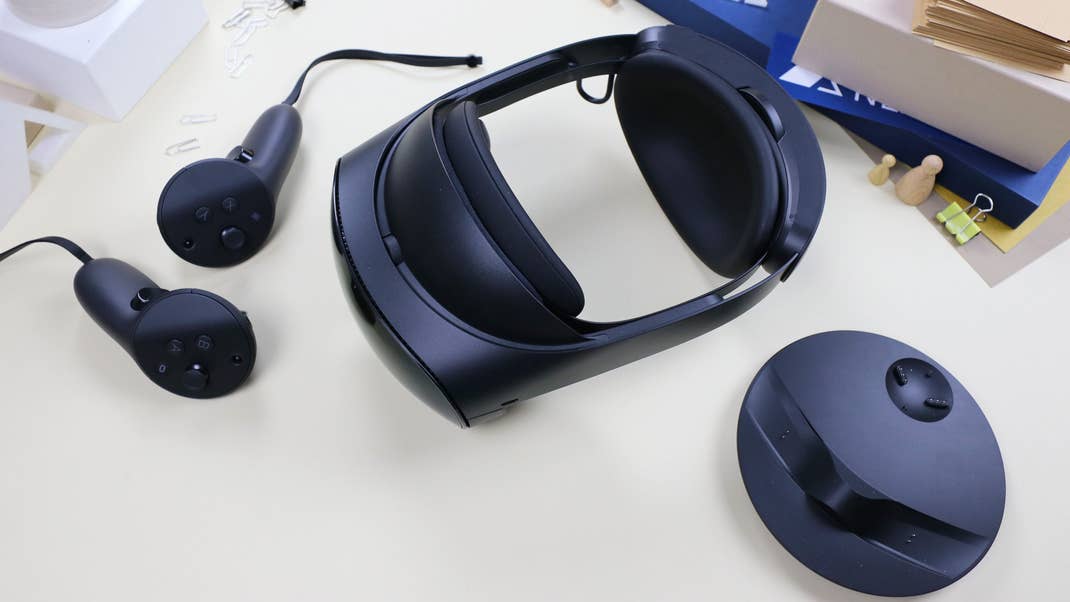
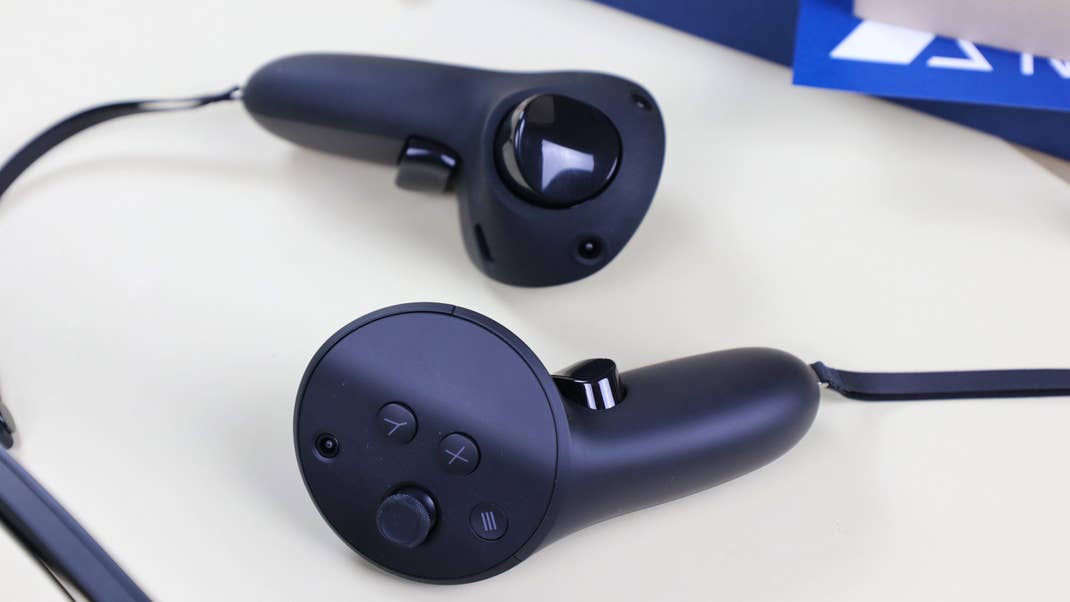
The Meta Quest Pro comes with two new “Pro Controllers” which are visually striking due to the missing tracking ring. They now have three 6DoF tracking cameras per controller and their own Snapdragon 662 SoCs. Their own tracking capability now allows them to practically track 360 degrees, doing so behind your back even. This means a far more precise tracking capability that showcases its strengths, especially in fast games.
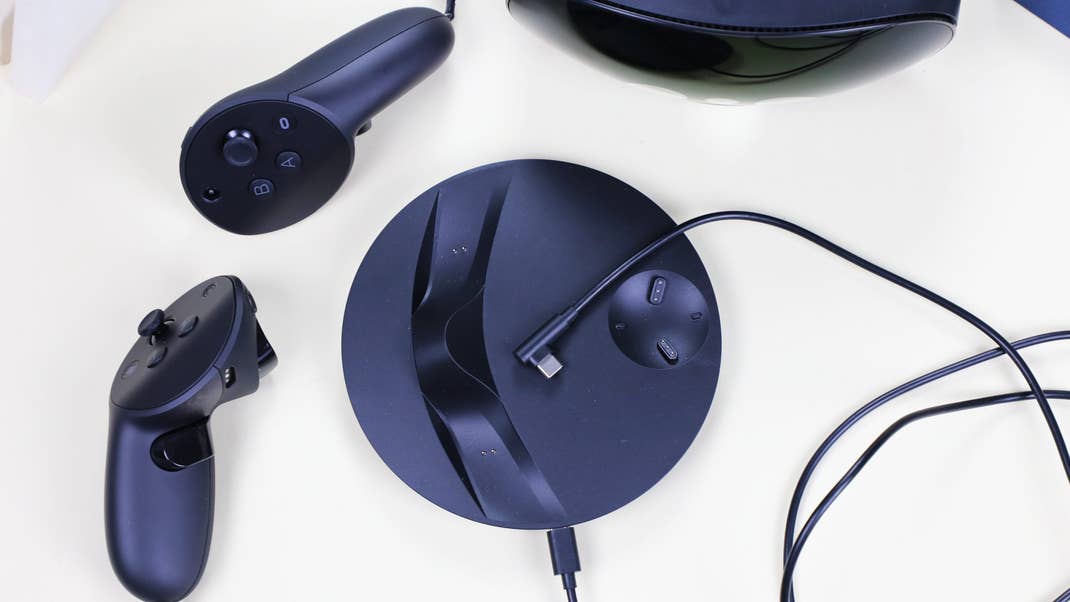
The topic of battery life is a real pivotal point when it comes to one-in-all headsets. After all, the self-sufficient form factor is what made it an all-in-one headset in the first place. It is therefore almost a bit disappointing that the runtime of the unknown large and permanently installed battery is only specified at two hours according to the technical specifications. The same applies after a full charge at the charging cradle.
What I liked:
Two to three hours of playtime are possible.
A charging dock is included.
What I disliked:
Battery cannot be hot-swapped.
Controller battery is not interchangeable.
Inserting the headset into the charging cradle is rather tight.
Here, the HTC Vive XR Elite once again exhibits a clear advantage as its battery can be changed during operation (via hot swapping). Of course, the Meta Quest Pro can be powered by an external battery via the USB Type-C port, which would theoretically extend the runtime.
We were a bit disappointed to learn that the controller’s batteries are not replaceable. Presumably, they comfort themselves that with an average runtime of 8 hours, they will automatically store more than enough juice more often than not due to the forced charging of the VR goggles.
That is also true so far, as long as you do not use the new 164 g controllers elsewhere meanwhile. This is because they are also compatible with the Quest 2 and could definitely offer advantages in a “Beat Saber” battle.
2x 1,800 x 1,920 (3,600 x 1,920) pixels 72/90 Hz refresh rate 106° horizontal field of view 96° vertical field of view Pancake Glass Lens 55 – 75 mm (IPD)
4x 6DoF inside-out tracking camera 1x RGB camera IR eye tracking IR face tracking
Battery / Runtime
mAh unknown 1-2 hours runtime Charging Dock (48W)
Connectivity
Wi-Fi 6E – 2.4 GHz – 5 GHz – 6 GHz Bluetooth 5.2
Sound
Stereo speakers 3D Spatial Sound 3x microphones
Other
USB Type-C port 2x 3.5 mm (R/L) jack connection Air Link connection to PC Link cable connection to PC (USB-C to USB-A) RGB passthrough
Controller
Specifications per controller: Qualcomm Snapdragon 662 3x 6DoF Joystick and buttons 6-axis sensor (gyroscope) HyperSense vibration motor Rechargeable battery 10 hours runtime
Operating system
Android
Price
October 25, 2022 (USA) MSRP US$1,500 December 9, 2022 (GER) RRP 1,799.99 Euros
Final verdict
The Meta Quest Pro costs only $999 now instead of $1,500 when it was first released. This means Meta realized that the Pro cannot be sold at that price. Nevertheless, it is still not a bargain compared to a Meta Quest 2 or worse, the Pico 4. In this respect, it seems to me that the Meta Quest Pro is actually more suitable for use in companies where eye and face tracking are utilized.
It is understandable that Meta classified the Quest Pro as a pure B2B device and would rather target consumers with the Meta Quest 3. Of course, the tide may turn completely with the release of an Apple Reality One or Reality Pro.
The VR goggles do many things better than their predecessor, although I expected more in terms of RGB passthrough. The Quest Pro has shed the bulky design of the Quest 2. The pancake lenses offer a much better look, even for those of us who wear eyeglasses. The stereo sound does work and if required, stereo headphones with a corresponding jack can be plugged in.
The new and revised controllers are noticeably better than in the predecessor and the eye and face tracking also seems to be on the right track. In this respect, it remains a bit of a surprise what Meta has to offer us with the Quest 3 in fall 2023.
Thus, the Meta Quest Pro is a device that targets those who absolutely want to play in VR and MR and are pretty well-off, while value having the latest technology. Entrepreneurs are addressed with this all-in-one headset. The next international meeting in virtual reality? Not a problem at all. Everyone else who is more interested in gaming will be able to find better options in our standalone VR glasses comparison.
We mark partner links with this symbol. If you click on one of these links or buttons–or make a purchase through them–we may receive a small commission from the retailer. This doesn’t affect the price you pay, but it helps us keep nextpit free for everyone. Thanks for your support! Prices are based on the date of publication of this article and may be subject to change.