

In Elon Musk’s world, the future is not something that just happens – it is announced with big words. Loudly, visionarily, and with great regularity. But if you take a closer look, Musk’s grandiose promises are not the predictions of an incorrigible optimist and mastermind. Rather, we see a recurring strategic instrument in action! These announcements are not random visions, but calculated maneuvers. The timing, conspicuously often just before the announcement of crucial quarterly figures, exposes their primary function: to deliberately influence the share price and calm nervous investors during critical phases. It is the art of controlling the narrative before the bare figures do. Or the short, more honest definition: Elon Musk is lying!
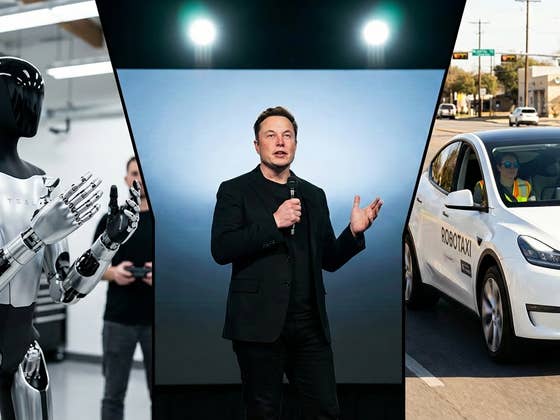
The most recent and perhaps most audacious example of this tactic is the debacle surrounding the humanoid robot Optimus, but Musk is once again demonstrating his imagination with Robotaxis.
Optimus robots in lifestyle part-time
The vision was grandiose: an army of autonomous humanoid robots that would make human labor in Tesla’s factories redundant. But the reality is sobering. In June 2024, the official Tesla account proudly announced that two robots were already in use, autonomously performing tasks in the factory. Only a little later, Musk raised expectations and predicted that between a thousand and several thousand robots would be working in his factories by 2025.
In January 2025, during the investor call for the Q4 2024 results, Musk raised the stakes dramatically: the internal plan was to build approximately 10,000 Optimus robots over the course of the year. He is confident that several thousand of these robots will be doing useful things by the end of the year.
Fast forward: we are in January 2026. One year later, on the call for the Q4 2025 figures, the illusion was shattered. Musk had to meekly admit that, believe it or not, zero (!) robots are doing useful work in the factories. The entire project is still in the research and development phase. So the isolated Optimus robots are so far just lukewarm malochers that mainly watch humans at work.
The system of deception became apparent as early as 2024. At the presentation of its Robotaxis, Optimus robots served guests at a bar, an only seemingly impressive demonstration of autonomy. It soon became apparent that the robots were remotely controlled by humans. So while Musk was already talking about thousands of autonomous robots, the reality was a remote-controlled puppet show. But hey, after all, four years ago at his robot event, he simply put a human in a robot costume:
The ghost ride of the Robotaxis
But speaking of robotaxis, the Robotaxis procedure follows the same script. On January 22, 2026, less than a week before the announcement of the Q4 figures for 2025, Musk announced that Tesla had begun robotaxi rides in Austin without a safety driver. The market reacted accordingly: the share price rose by 4 percent. A perfectly timed marketing stunt to distract from another year of falling vehicle sales.
But on closer inspection, the claim is once again just a lifeless shell. Despite an intensive search, no one has been able to confirm the existence of these driverless rides. The Tesla enthusiast David Moss made 42 trips in an attempt to find such a vehicle; on each occasion, a safety driver was in the car.
For a revolution that supposedly started, a remarkably invisible one, if you ask me. What’s more, even the few vehicles that were supposedly driverless were supervised by a staffed escort vehicle. So the supervision was not removed, it was merely moved to another car – a sleight of hand that was enough to boost the share price by four percent.
The Musk system
The cases analyzed here are not simply the erroneous predictions of an over-optimistic visionary. They are proof of a calculated communication strategy. When the CEO of a listed company makes such a concrete, short-term operational claim – for example, that thousands of robots will be doing useful work by the end of the year – and then admits a year later that the actual number is zero, it is not a miscalculation. It is a deliberate misrepresentation of investors.
The purpose of these recurring marketing stunts is clear: to control the narrative, drive public perception, and have a material financial impact on share value. And yes, it happens just when the company needs it most. The announcements serve as a bridge over bad news or disappointing financials by shifting the focus to a glorious but fictional future.
We have unfortunately arrived at a time when a company’s market capitalization no longer depends solely on tangible products and profits. It is enough to simply offer a well-told story. For you and for investors, the question is no longer if, but when the hype will give way to reality, and the house of cards on which billions in market capitalization rest will collapse.
Are you still falling for Elon Musk’s lies? Or are you just as skeptical of every spectacular new announcement as I am now?