



Let’s imagine for a moment that the transatlantic friendship is not just a romantic relic of the last century, but a reliable constant. A nice thought, but a false one. In Washington, an erratic Donald Trump is arranging world politics in a lordly manner and rearranging it via social media decrees, while at the same time maneuvering his country into civil war. Meanwhile, Europe seems powerless, frozen like a deer in headlights. It has maneuvered itself into a digital servitude that is unparalleled.
Is that changing now? The Wall Street Journal has pointed out that there is now a flurry of activity in the EU.
Silicon Valley obeys Trump
It is a bizarre spectacle: on the one hand, there are the US tech giants, those supposed do-gooders from Silicon Valley, who prophylactically drop to their knees at the first sound from the White House. They vie for the favor of a man whose only constant is his unpredictability and declare their unconditional loyalty to him. And what about us Europeans? We sit in Brussels, Berlin, and Paris and fervently hope that the plug on which our entire administration, our economy, and our private lives hang will not become the plaything of a nighttime whim. We are exactly one presidential decree away from disaster.
This corporate ass-kissing (pardon my French) illustrates all too clearly: when push comes to shove, it’s not data protection in Bavaria that counts, but the share price on the Nasdaq and peace with the would-be king. Our dependence on Microsoft, Google, and Apple is no longer a convenience – it is a strategic declaration of bankruptcy. It’s time to cut the digital umbilical cord before the oxygen is simply cut off overseas. It is the last desperate act of self-assertion by a continent that has forgotten how to stand on its own two feet technologically.
In my analysis, I put my finger in the wound: we take a look at the risks – from legal dead ends to market dominance -, expose the bogus solutions offered by US providers, and show how Europe is already laying the foundations for genuine digital freedom.
The core problem: we’re on a drip
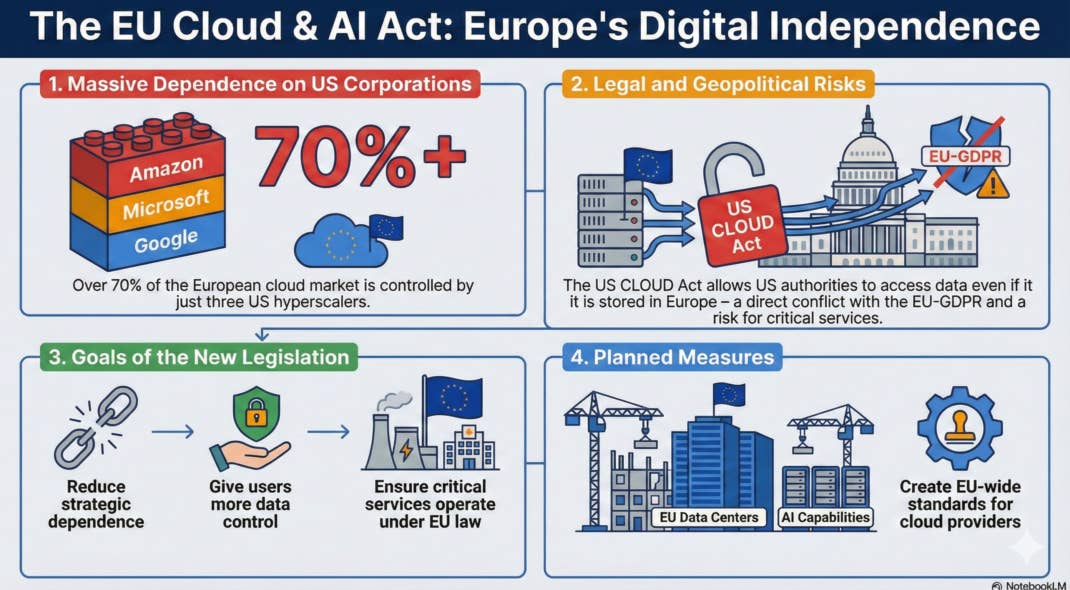
Dependence on US technology is not an abstract concern, but a real threat to our economy and sovereignty. A look at the figures is sobering: over 80 percent of our digital products come from outside the EU. In the cloud sector, US providers control a whopping 83% of the market. This not only stifles domestic innovation but also makes us vulnerable to blackmail.
Added to this is the permanent legal cinch: our GDPR collides head-on with the US CLOUD Act. The latter forces US companies to hand over data, no matter where in the world it is stored. Contracts with customers count for little; the US federal law trumps everything. Just how serious the situation is was demonstrated in July 2025: in front of the French Senate, Microsoft France’s chief lawyer was unable to rule out the possibility of data flowing to US authorities without consent.
The fear of a “digital kill switch” – i.e., the shutdown of critical infrastructure by Washington – is therefore no longer a Hollywood scenario, but a plausible geopolitical means of exerting pressure. A simple order could render us incapable of action tomorrow.
The US response: Sovereignty as a marketing gimmick?
To alleviate the pressure from Brussels, Microsoft, AWS, and Google are now presenting “sovereign” solutions. This means our data is stored on their servers, which are still located in Europe. For example, Google in Munich and Amazon in Brandenburg are trying this out. But beware: this is often more pretense than reality. Critics call it “sovereignty washing”.
Although there are technical controls and local partners, this does not change the legal subordination to US laws. In the end, these offers are mainly tactical maneuvers to secure market share without relinquishing real control. Europe must make a decision: Do we want dependency with a new label or real alternatives?
Europe’s awakening: the path to the “Eurostack”
Europe is no longer waiting. The political will for emancipation is there: at the beginning of 2026, the EU Parliament called for technological sovereignty with a huge majority. The trend is clearly towards “Buy European”.
The EU is planning the Cloud and AI Development Act (CADA) for early 2026 in order to not only establish rules, but also to play in the premier league again in terms of technology. While previous laws mainly stipulate what AI may not do, the CADA is intended to roll up its sleeves. The aim: to establish genuine European “AI gigafactories”. This involves massive computing power and cloud infrastructures under EU control so that we no longer have to train our AI models on Microsoft or Google servers. It is the industrial policy backbone for the “Eurostack”.
But what is the point of supporting local companies if they are swallowed up by US giants shortly afterwards? The takeover of Dutch supplier Solvinity by Kyndryl at the end of 2025 was a wake-up call. Sovereignty not only needs orders, but also protection against sell-offs.
They do exist, the European rays of hope
At the same time, open source projects are showing that things can be done without Silicon Valley:
- OpenDesk: The alternative to Microsoft 365 being pushed by the German Ministry of the Interior. It uses tools such as LibreOffice and Nextcloud and is already being used successfully – even at the International Criminal Court.
- Nextcloud: This platform proves every day to authorities across Europe that working securely on their own infrastructure is possible.
The goal is a “Eurostack”: an industrial policy based on three pillars: “Buy European” (prioritize procurement), “Build European” (encourage private investment), and “Fund European” (targeted public funding). We don’t need isolation, but we do need a stable market share of 30 to 40 percent so that we no longer have to hang on to the drip.
Conclusion: Action instead of hope
The time for naïve faith in technology is over. Anyone who believes that digital infrastructure is safe with a partner who wants to buy Greenland in passing, like a property in need of renovation, is suffering from a dangerous denial of reality. Trump’s erratic course – from bizarre territorial claims to the security-policy egg dance over Ukraine – shows one thing unmistakably: reliability has become a currency in Washington that is no longer worth anything.
If the US is prepared to sacrifice long-standing allies and global security guarantees for a headline or a personal deal, then it is only a matter of time before the European data flow is also sacrificed to the MAGA cult. Anyone who voluntarily accepts this dependency today should not be surprised tomorrow when they wake up as a geopolitical bargaining chip.
One thing is clear: digital sovereignty is not a niche topic for IT experts, but a question of survival for our continent. The path to independence will cost money and require courage. But there is no alternative if we want to defend our values and our freedom of action in a digital world. The tools are there – we must now use them consistently.