

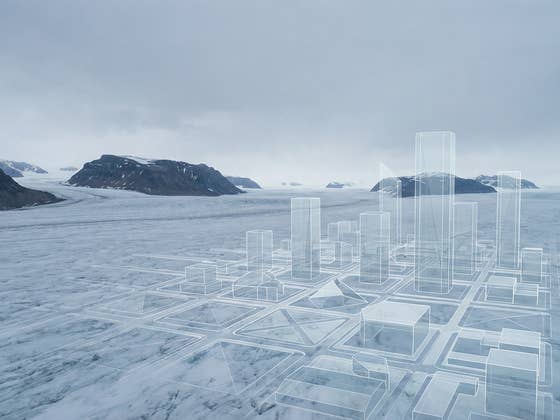
When you think of new cities, images of careful planning, sustainable infrastructure, and social cohesion probably come to mind. The vision of a “Freedom City”, which is currently being discussed by referencing Greenland, is the exact opposite. This is not about contributing to the common good, but about establishing a highly deregulated special zone — an experimental field for capital and technology, freed from the shackles we commonly refer to as democracy, law, and the public order sphere.
The Ideology Behind It: More Than Just a City
However, this idea is not a government initiative. It hails from the think tanks of the tech and investor scene, driven by groups like Praxis, which receives capital from funds backed by tech giants like Marc Andreessen and Peter Thiel. At the head of Praxis sits Dryden Brown, who describes Greenland as “one of the last frontiers on earth” and promotes the concept of so-called “network states”.
Behind this lies the fantasy of libertarian utopias and parts of the tech billionaire clique: communities that emerge online, purchase territories via crowdfunding, and establish themselves as tax-free enclaves, governed by a “king-CEO” at the head of “citizen shareholders”. But why should sparsely populated, icy Greenland, of all places, become the setting for this radical vision?
Greenland as a Projection Surface: The Perfect Laboratory
The obvious answer? Raw materials. However, that is too simplistic. Greenland does indeed have significant deposits of rare earths, but the reality is sobering: extraction is costly, logistically complex, and politically sensitive. After all, Greenland’s pack ice is kilometers thick in certain places! Local resistance to environmental risks, such as concerns about radioactive pollution from uranium mining, has already blocked ambitious projects in the past. Greenland’s government also banned new oil and gas exploration in 2021 for climate protection reasons. Quick profits are nowhere to be seen here.
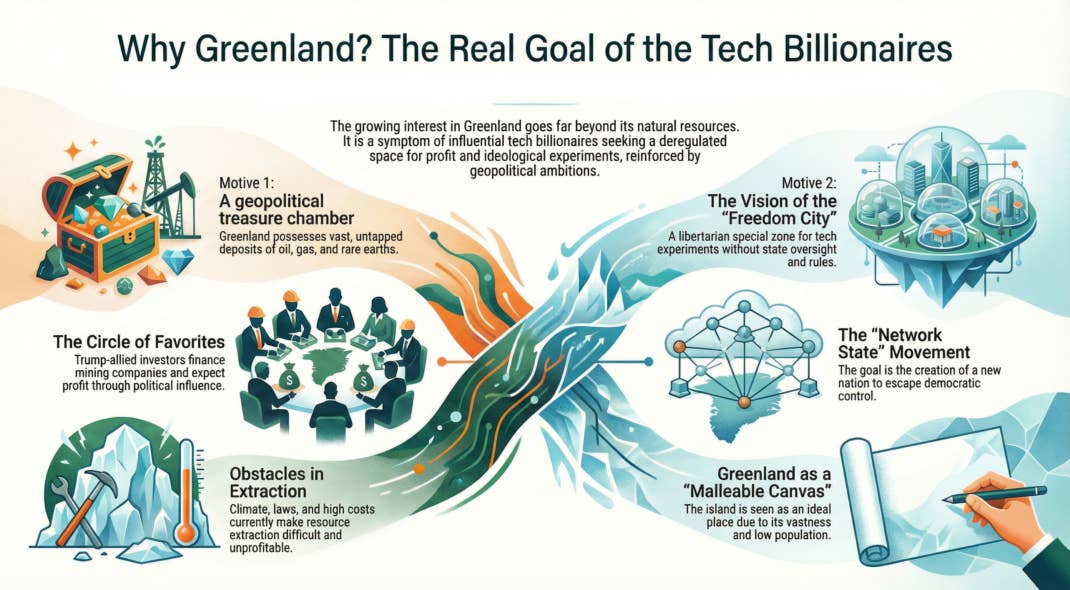
So yes: Greenland is much more than a mine for these visionaries. It is a projection surface — and the perfect laboratory for the desired “network state”. Greenland seems perfect for this vision: a huge, almost empty territory with a complex autonomy status, somehow caught between self-government and Danish sovereignty. In the eyes of tech investors, such a place appears malleable, negotiable, and resistant. It is the ideal political canvas on which to build a new model of society without the burdens of a democratic legacy. This perception of malleability almost inevitably brings a political figure onto the scene who is prepared to ignore established rules.
Trump as an Accelerant: How an Idea Becomes Socially Acceptable
Donald Trump is not the architect of these plans; we must take note of that here. But he is their key political tool. With his typical ignorance of diplomatic conventions, he is pouring barrels of erratic oil onto a fire that others have long since been lit. But it is more than that: he provides the state power to turn a libertarian fantasy into reality. The best proof of this? Trump’s appointment of Ken Howery — a venture capitalist and PayPal co-founder alongside Peter Thiel — as US ambassador to Denmark. He was explicitly tasked by the Trump administration to lead the takeover negotiations for Greenland. Praxis’s social media channels commented on this dryly with: “According to plan.”
Under the guise of national security, the private-sector interests of his oligarchic supporters are thus declared to be strategic necessities. And these are the same figures who both finance the utopian network states and are invested in the mining companies. People who would benefit directly from a US takeover. Whether KoBold Metals, backed by Jeff Bezos and Mark Zuckerberg, or Critical Metals Corp, backed by Trump’s Secretary of Commerce Howard Lutnick, they all form a closed loop of greed, power, and political influence. The reason for being? Private interests, nothing else!
The Big Exit: When Democratic Society Becomes a Risk
The Greenland project is not a standalone situation. It is a symptom of a worrying paradigm shift among the tech elite. For years, we have seen an exodus of billionaires from innovation hubs like California to more tax- and regulation-friendly areas. They are fleeing because they want to protect their mountains of money. This is because they consider themselves too regulated and perhaps also because they don’t want to spend too much time with the hoi polloi. At the same time, fantasies of private bunkers and entire private cities are emerging. The common thrust is unmistakable: withdrawal from society.
There is a profound conviction behind this, which — if you ask me — reveals a central idea: Society is increasingly seen as a disruptive factor, regulation as an obstacle, the public as a risk. In this logic, freedom is radically redefined. It is no longer about freedom for the many within a democratic framework, but about absolute freedom from rules for the few. But deregulation is never neutral. It shifts power — almost without exception, in favor of those who already hold the best cards. The rest of us are just puppets in this game. Nothing more than voting and consumer cattle.
Conclusion: Freedom City – A Symptom Instead of a Future Model
The “Freedom City” is not a desirable model for the future. It is the little bastard that would emerge if you crossed Taka-Tuka-Land with Silicon Valley and sprinkled a good amount of narcissistic glitter on top. It is the alarming symptom of an unholy alliance of libertarian tech utopias, ruthless geopolitical power games, and an elitist mindset that is rehearsing its exit from the democratic community of solidarity. Greenland is less a concrete goal than a symbol of a mindset that wants to replace democratic negotiation processes with private, controlled spaces.
The real question is, therefore, not whether these cities will ever be built. Rather, how much of this thinking has already become political reality, long before the first foundation stone is laid. On the surface, it’s about security and raw materials when we talk about Greenland. But do bear these elitist plans in mind that have been maturing in the souls of the billionaire offices for so long.
What do you think of these plans? Do you see them as an opportunity or a danger? Share your opinion in the comments!